Wednesday, 23 October 2019

Snuffy Davy

Recent mention of Caxton's Game and Playe of the Chesse recalls the oft-repeated tale of Snuffy Davy from Walter Scott's novel The Antiquary which he wrote in the early months of 1816, setting the story in Scotland in the 1790s. The book was first published in Edinburgh and London in May 1816 in an edition of 6,000 copies.


What is seldom repeated are the circumstances surrounding the telling of the Snuffy Davy anecdote. 

The novel's main character, an antiquary named Jonathan Oldbuck, Laird of Monkbarns, north of Edinburgh, (and largely a self-portrait of Scott himself *), is a collector of antiquities and in particular old and rare books. However, he had a distinct aversion to second-hand book dealers, whom he dismissed as "peripatetic middlemen", preferring to track down volumes for his library from primary sources using his own time and toil.

Here then is the full anecdote from pages 56 to 59 of the first edition of The Antiquary, volume I, narrated in Scott's delightful early nineteenth-century prose:


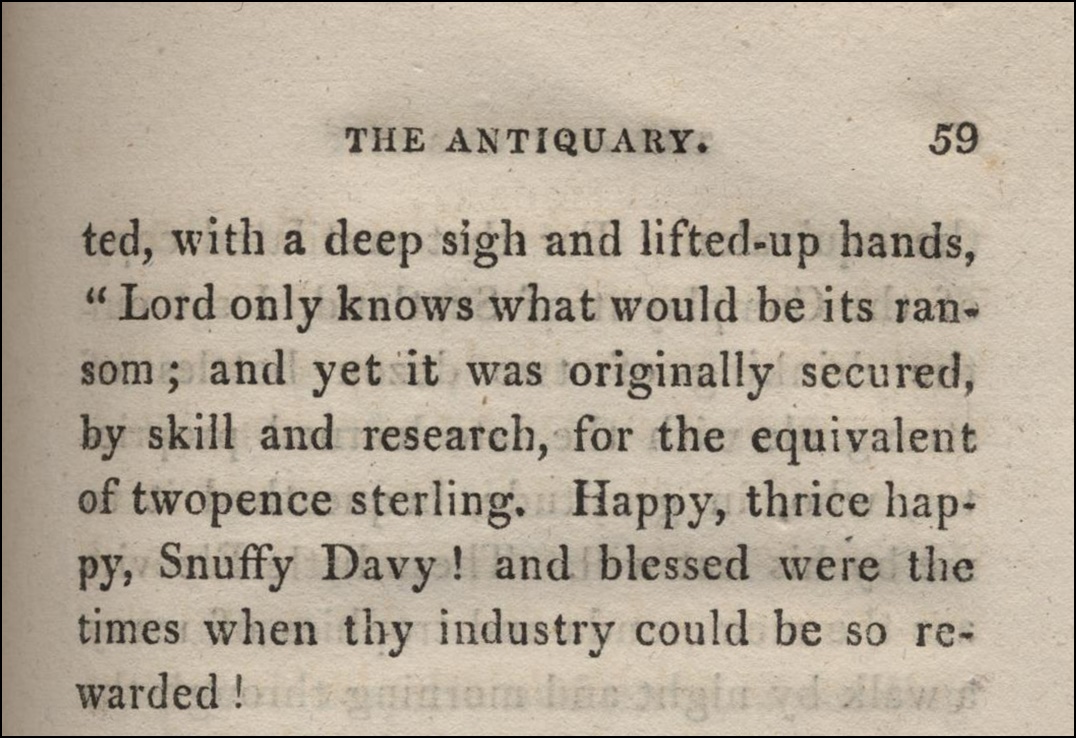


Oldbuck continues by relating details of a few treasures that he has unearthed himself in this manner, and vividly portrays the fervour and emotions experienced by all collectors as they hunt their quarry:


The anecdote is included in William Axon's Introduction to the verbatim reprint of Caxton's Game and Playe of the Chesse, published by Elliot Stock, London 1883, together with considerable information on the printing of Caxton's work, the whereabouts of the ten known copies (in 1883), and details of sales of this very rare volume, the first book on chess to be printed in English. The British Chess Magazine reprinted Elliot Stock's book in 1968.


The story can also be found in Chess Pieces by Norman Knight, London 1949, pages 99 - 100, followed by further information on Caxton's book.

The British Chess Magazine for December 1891 contains an article about Sir Walter Scott by HRH, on pages 530-531, with details of many references to chess in Scott's writings, but, curiously, there is no mention of the Snuffy Davy episode. An abridged version of this article is on pages 276-277 of Reinfeld's The Treasury of Chess Lore, London 1955.

The British Chess Magazine for June 1946, pages 186-187, gives brief details of the sale of Lord Cunliffe's library including a first edition of Game and Playe of the Chesse which sold for £1,900. This is also included in The Treasury of Chess Lore on page 290.

* This information and a few other details are taken from the walterscott.lib.ed.ac.uk website.


                                         © Michael Clapham 2019

Wednesday, 16 October 2019

Chess Book Exhibitions; Part 3

The Chess Collection of George Allen, The Library Company of Philadelphia


This typescript pamphlet of 24 pages has no title page and very little introductory matter, just a short paragraph on George Allen (1808-1876):


However, this appears to be the catalogue for an exhibition, held from July to September 1979 at the Library Company of Philadelphia, of items from the George Allen collection acquired by the Library in 1878. Penn Libraries give a publication date of 1980 and names Kevin Coghlan and Sandra Nathanson as contributors. 

The catalogue lists 60 items and each one is described in detail with much illuminating information; there is also a handful of poor quality illustrations. Almost a quarter of the exhibits were associated with the Automaton Chess Player.

The first items listed are Illustrations from the Allen Scrapbooks; three lithographs of von Kempelen's Automaton Chess Player dated 1783, two broadsides printed after Maelzel's acquisition of the machine, a lithograph of Louis Paulsen playing Max Lange,  and a lithotint of the competitors in the first American Chess Congress of 1857.


The next section gives details of eleven books and letters relating to the Automaton, including works by von Windisch 1783, Racknitz 1789, Hindenburg 1784, Hunneman, 1820, Observations on the Automaton Chess Player by an Oxford Graduate 1819, Robert Willis 1821, Gamaliel Bradford 1826 and William Schlumberger.

The compiler of this catalogue makes the unfounded suggestion that the "Oxford Graduate" may have been Maelzel himself.


Among the exhibits was a letter from William Lewis to George Allen recounting his experiences with Maelzel and the Automaton, including an occasion when suspicions arose concerning the player hidden inside; Lewis arranged for his friend W. Hunneman to direct the machine while he socialised with his suspicious chess-playing friends.

The next section is titled The Milieu of the First American Chess Congress and includes books, letters and other ephemera pertaining to that event. Periodicals of the era on display included the complete eleven volume run of Le Palamède from 1836 to 1847, The Philidorian 1838, The Chess Palladium and Mathematical Sphinx 1846, and Fiske's Chess Monthly 1857. The final item in this section is Chess in Philadelphia by Gustavus Reichhelm and Walter Shipley, published in 1898; obviously acquired post George Allen, and no doubt included on account of the considerable amount of Morphy material in the book.  


The section headed Nineteenth-Century European Chess Masters includes books by Alexander Petroff, William Lewis, Bilguer and Kieseritzky together with handwritten items by Petroff, Alexander MacDonnell, Saint Amant and Kieseritzky.


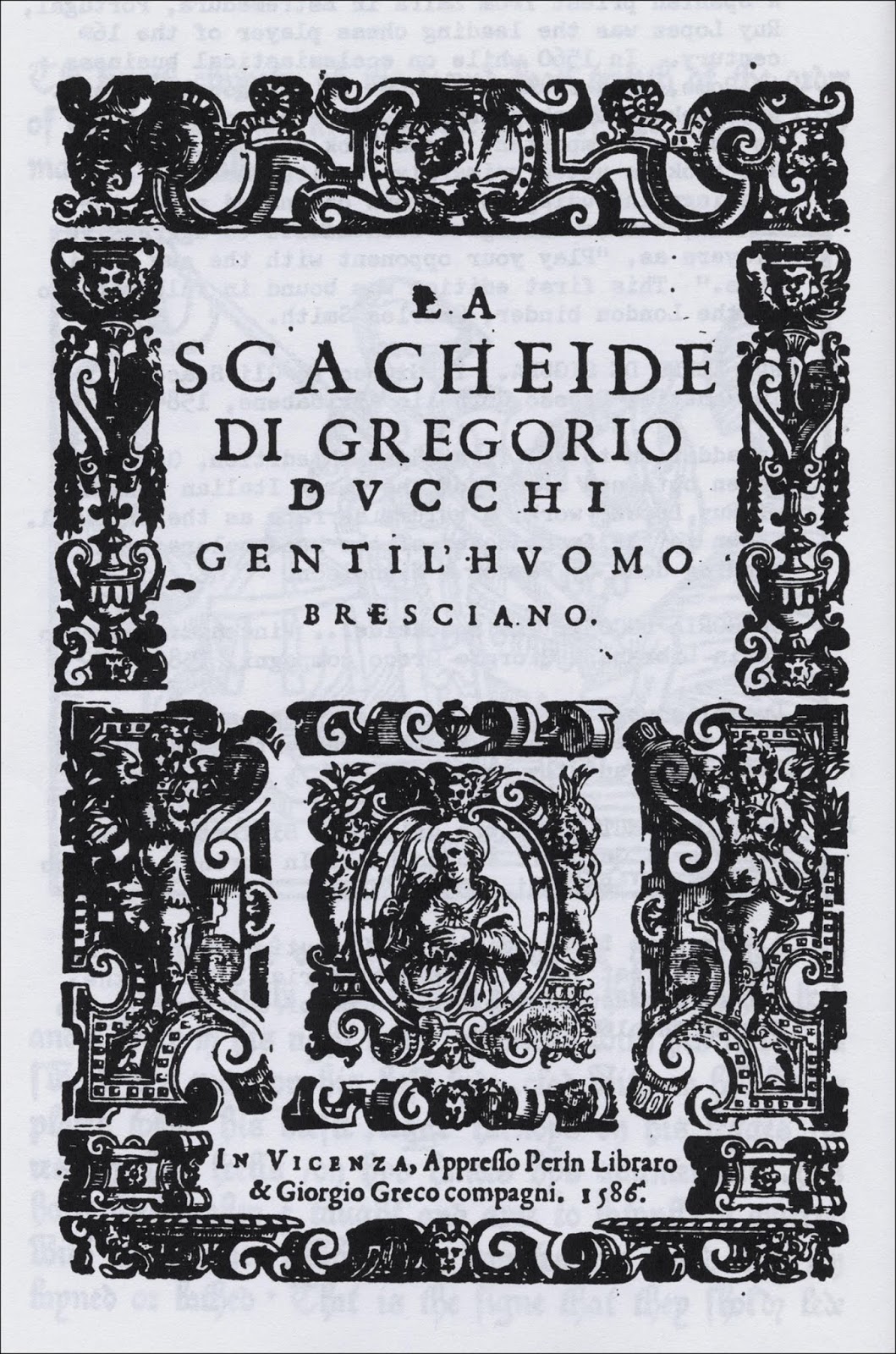
The catalogue concludes with Select Volumes from the History of Chess and gives details of a 15th century manuscript by Jacobus de Cessolis, and many of the important works of the 16th and 17th centuries including Damiano 1512, Vida 1527, Mennel 1536, Ruy Lopez 1561 and 1584, Ducchi 1586, Gianutio 1597, Salvio 1604, Selenus 1616, Carrera 1617, Philidor 1749, Cozio 1766 and Twiss 1787.


A number of items in this exhibition had previously been exhibited at the Grolier Club in 1975.


Monday, 14 October 2019

Chess Book Exhibitions; Part 2

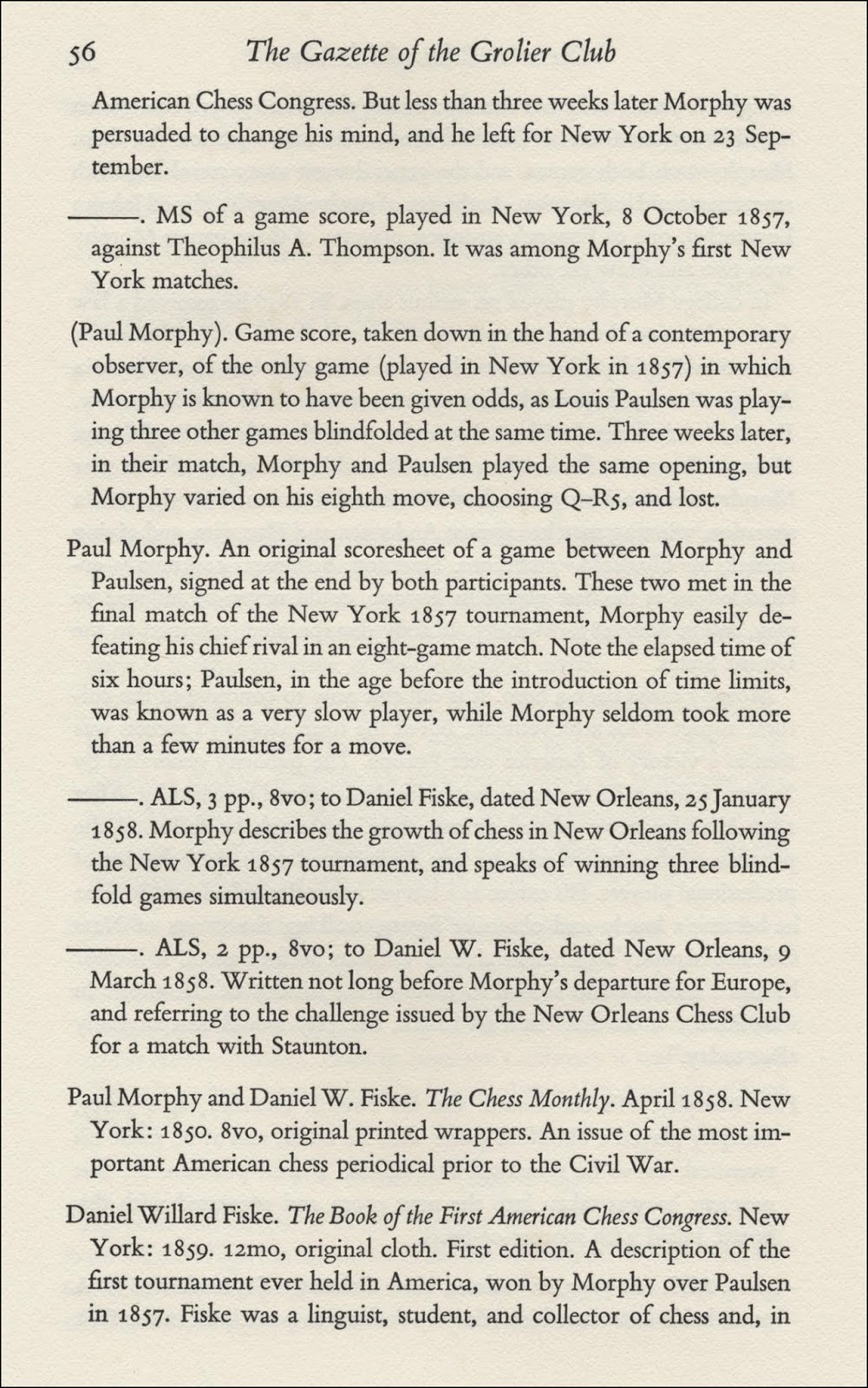
Chess: A Bibliophile's View was the title of an exhibition held at the Grolier Club, New York, from 21st October to 6th December 1975, and the Gazette of the Grolier Club, for June/December 1975, included a Catalogue of the Exhibition on pages 38 to 76.


This remarkable exhibition was planned as an afterpiece to Bobby Fischer's first defence of his world championship title, which, as Stephen Weissman dryly observes in his introduction: "sadly, never took place; exhibition schedules, however, are not so easily ignored, and it was decided by the committee that match or no, the show must go on"


Weissman selected the exhibits and states "I have tried to be fairly complete in my selection of early books on the practical theory of chess, and reasonably thorough in choosing printed versions of important tournaments and matches".

Following his introduction, Weissman lists the circa 200 exhibits ranging from 14th century manuscripts to handwritten items from the 1970s by Fischer and Karpov. Every item is described in some detail, along with introductory remarks on many of the chess personalities featured, (although some of the observations are contentious). Unfortunately, no illustrations are included in the catalogue.


The Catalogue is in chronological order and is extraordinarily rich in the very earliest chess works beginning with seven manuscripts and nine printed books all dated before 1500! 


The incunabula included Caxton's The Game and Playe of the Chesse, Bruges 1475, described in the catalogue as "The most sought after of all printed books on chess", and also Artes orandi, epistolandi, memorandi, by Jacopo Publicio, Venice 1482, which has a woodcut of a chessboard on the last leaf, claimed to be the very first such representation to appear in a printed book.

The illustration below is from a 1490 edition of the same work, courtesy of Jurgen Stigter. (See also LN 4677)


First edition works from the sixteenth century by Jacob Mennel (1507),  Damiano (1512), Ruy Lopez (1561), Rowbothum (1562), Thomas Actius (1583), Gregorio Ducchi (1586), and Gianutio (1597), are all included and the treasures carried on through the seventeenth and eighteenth centuries with volumes by Salvio (1604), Selenus (1616), Carrera (1617), Saul (1618), Greco (1656), Hyde (1694), Bertin (1735), Philidor (1749), Hoyle (1761). Lambe (1764) and others. 


Ten books and pamphlets discussing von Kempelen's Automaton were exhibited and a large collection of Paul Morphy memorabilia was on display, including his chessboard, letters, scoresheets, the bust by Lequesne, photograph etc.


Many of the most important and influential chess books of the last 500 years, were on display along with a considerable number of manuscripts, letters and other ephemera, with examples from Sarratt, Deschapelles, Saint-Amant, Kieseritzky, Staunton, Löwenthal, Pillsbury and many of the leading chess figures from the 20th century. (Incidentally, a two-line hand-written note of fourteen words by La Bourdonnais dated 1837 sold for £3,380 at auction recently.) 


A bound volume of virtually all of the original scoresheets from New York 1924 was on display, opened at Reti's scoresheet for his famous win against Capablanca. Three further items in Capablanca's hand were also exhibited:   


A small number of bibliographical works were displayed including A Catalogue of Rare and Valuable Works relating to the History and Theory of the Game of Chess, being the Greater Portion of the Famous Library Formed by J. W. Rimington Wilson, London 1929; described as "The finest collection of chess books ever offered for sale."


The lenders to the exhibition were acknowledged as follows:


Friday, 11 October 2019

Chess Book Exhibitions; Part 1

Exhibitions of chess books are rarely arranged, but I have catalogues of three such events and give details in this, and the next two posts.

The Central Library of Barcelona organised an exhibition in March 1940, comprising mainly of books from the collection of Don José Paluzie y Lucena, and published a Catálogo de la Exposición Bibliográfica de Ajedrez  in 1943.


Paluzie y Lucena (born 1860, died 1938 according to Gaige, but twice recorded as 1935 in this catalogue) was a leading figure in Spanish chess circles; a first class player and with a special interest in chess problems, he wrote a number of chess books including the important Manuel de Ajedrez in three volumes, Barcelona 1911 -1913, and pioneered the publication of chess books in Esperanto. He assembled a large and impressive chess library, which he generously made available to others, and this was donated to the Biblioteca Central in Barcelona by his family following his death.  


The Catálogo lists 476 exhibits which were loosely divided into the following categories:


Books in many languages from around the world were exhibited, and each book is described in the Catálogo with basic bibliographical information. Naturally there were many Spanish works on display and it seems from these that Barcelona was a more prominent publishing centre than the capital Madrid. Few very early chess books were exhibited but an incomplete Repetición de Amores, e Arte de Axedre by Lucena, Salamanca 1497, was on display.  

There follows a page or two from each section of my damp stained copy of the Catálogo:

Manuales o Tratados elementales:


 Problemas de Ajedrez:


Concursos, Congresos, Torneos:


Historia y Bibliografia:


Miscelánea ajedrecista:


Revistas y Anuarios:


© Michael Clapham 2019

Monday, 12 August 2019

Rare early chess books and modern reprints.

Rare early chess books are out of reach for most collectors, however, exact replicas of some important works have been produced in recent years and these are much more accessible.

Here are three examples:

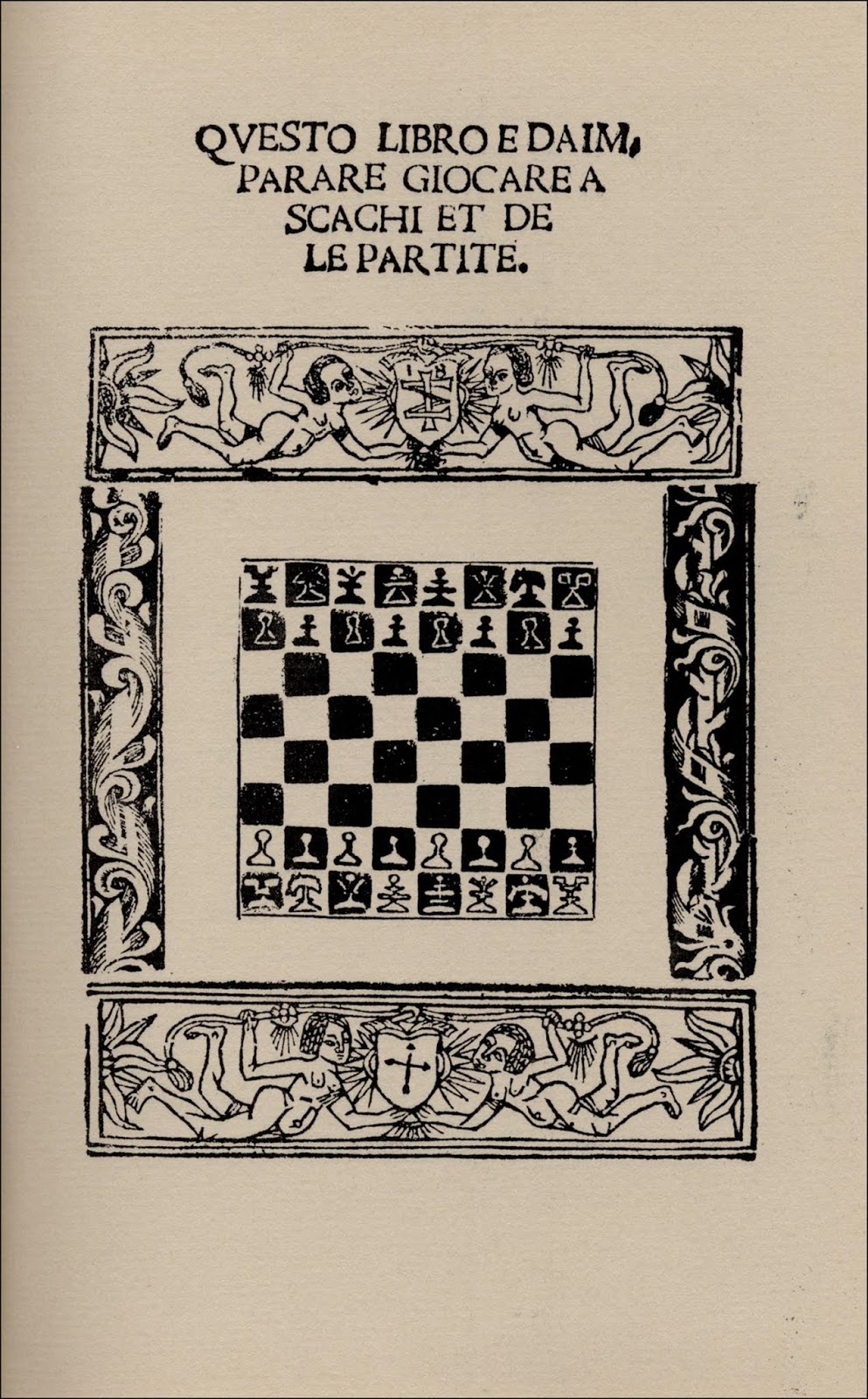
Questo libro e da imparare giocare a scacchi et de le partite, by Damiano de Odemira, Rome 1512.


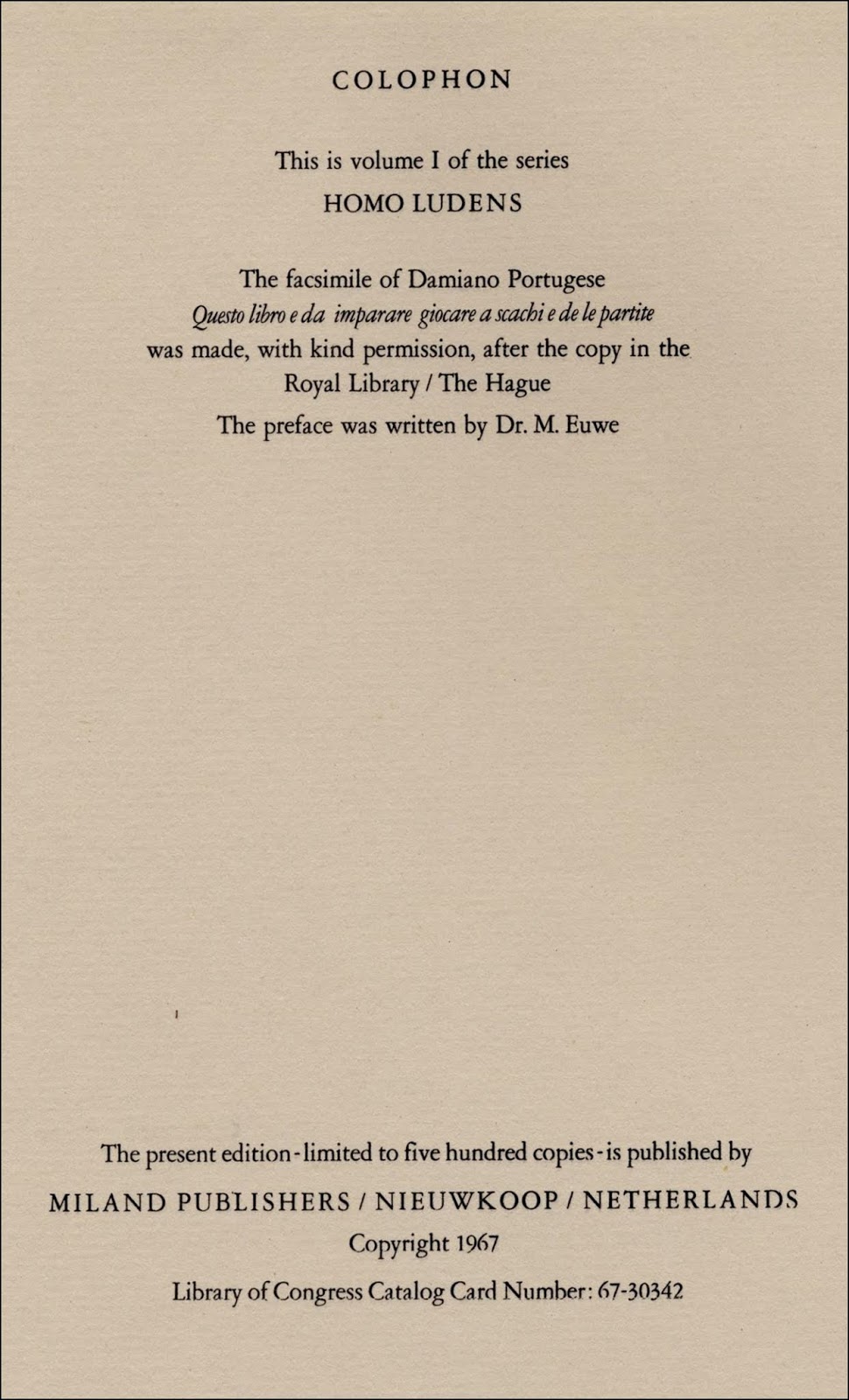
A facsimile of the first edition of Damiano was published by Miland Publishers of Nieuwkoop in 1967 in an edition of 500 copies. Although the title page, Preface by Dr. M. Euwe and the Colophon are all in English, this book is not recorded in Betts's Bibliography (1850 to 1968).


This reprint was produced from the copy in the Royal Library at The Hague but both the half title and title page, erroneously, give the title as Libro da imparare giocare a scachi, which was the title for the third edition onwards. 


The recognised first edition of Damiano, dated 1512, has 62 leaves and includes 92 fine woodcut chessboard illustrations.  The final leaf includes the words Nouiter Impressum (Latin for New Impression) which has led to speculation that there may have been an earlier edition. This matter was discussed, but unresolved, in The British Chess Magazine in 1906 and 1907 with extensive contributions by Ross Pinsent. 


Antonius van der Linde stated, in his Geschichte und Literatur des Schachspiels, Erster Band, page 340, that only three copies of the 1512 edition were known, viz., in the British Museum library, Athenaeum Library, Philadelphia, and The Hague. This was repeated in a number of later publications, including The British Chess Magazine for 1906, page 232, following which J. G. White wrote to the BCM, (1906 pages 423 - 427), claiming a fourth copy in his own collection and adding details of copies known to him of later editions, briefly: 1518 edition, three copies; 1524 edition, two copies; fourth undated edition, one copy; 1618 pirated edition, no copies known.

Further examples of the extremely rare first edition have since been discovered but there are probably less that ten copies in existence.

____________________________________________________

Libro de la invencion liberal y arte del juego del Axedrez, by Ruy Lopez de Sigura, Alcala 1561. 


The first edition of Lopez's famous work has 8 unnumbered leaves and 150 numbered leaves. The book is divided into four parts and 85 chapters. There are no chessboard illustrations but most chapters begin with historiated initials.

A small colophon indicates that this reprint was published by Librerias Paris-Valencia S.L. in 2001, but there is no other introductory information.


The original Spanish edition of Ruy Lopez was translated into various languages beginning with an imperfect Italian translation by Tarsia, published in Venice in 1584 and from this version Gustavus Selenus, i.e. Augustus, Duke of Brunswick- Lüneberg, produced his Schach-oder König-Spiel in Leipzig, 1616.  Selenus' book, a folio of 495 pages, was highly criticised by van der Linde in his Geschichte und Literatur des Schachspiels, Berlin 1874, Erster Band page 350, and was described by J. A. Leon as "perhaps the most tedious work on chess extant" in the first of his series Old Masters of Modern Chess in The British Chess Magazine 1894 page 396. The most attractive feature of Selenus' book is the number of fine specimens of early German copper-plating.

J. H. Sarratt published his English translation of Ruy Lopez in 1813*, taken from an edition in French published in Bruges in 1655. In 1817** Sarratt published an English translation of Selenus' work prompting this quip by J. A. Leon in the aforementioned BCM article: "In [1813] Sarratt published an English translation of the Bruges edition of 1655 [of Lopez], and in 1817 performed the same kindly office for Selenus' work, in sublime unconsciousness of the fact that the two were identical."

* The Works of Damiano, Ruy Lopez, and Salvio, on the Game of Chess, London 1813.

** The Works of Gianutio, and Gustavus Selenus, on the Game of Chess, London 1817.


Part II Chapter I
Part IV chapter III


The final leaf


______________________________________________________


The famous game of Chesse-play, by Arthur Saul, London 1614.  


A facsimile was published by Theatrum Orbis Terrarum, Amsterdam, and Walter J. Johnson, Norwood, New Jersey in 1974. This was reproduced from the copy in the British Library with one page taken from the copy in the Bodlein Library in Oxford.


Saul's small volume of thirty unnumbered leaves was the first original chess book published in English and his book was republished in 1618, a year after his death, with additions by Joseph Barbier. Five further editions, all by Barbier, appeared between 1640 and 1680. Only six copies of the first edition of 1614 are known, four in institutional libraries, and two in private hands. The most recent copy to surface was sold in a provincial auction in England in 2006 for £9,000.


The copy in the Cleveland Public Library and at least one other copy have a variant title page as shown on the left below:


The cumbersome notation in this book runs as follows:

"Let the white King for his first draught advance his owne Pawne into the fourth house of his owne file", or as we would say; e4.