Tuesday, 24 March 2020

Chess Digest, Melbourne, Australia

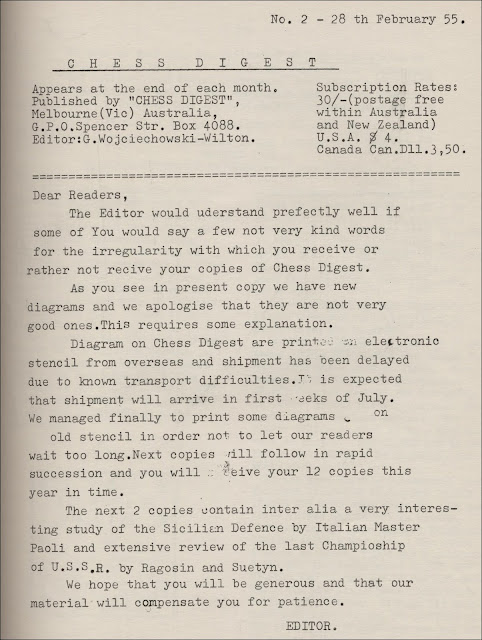
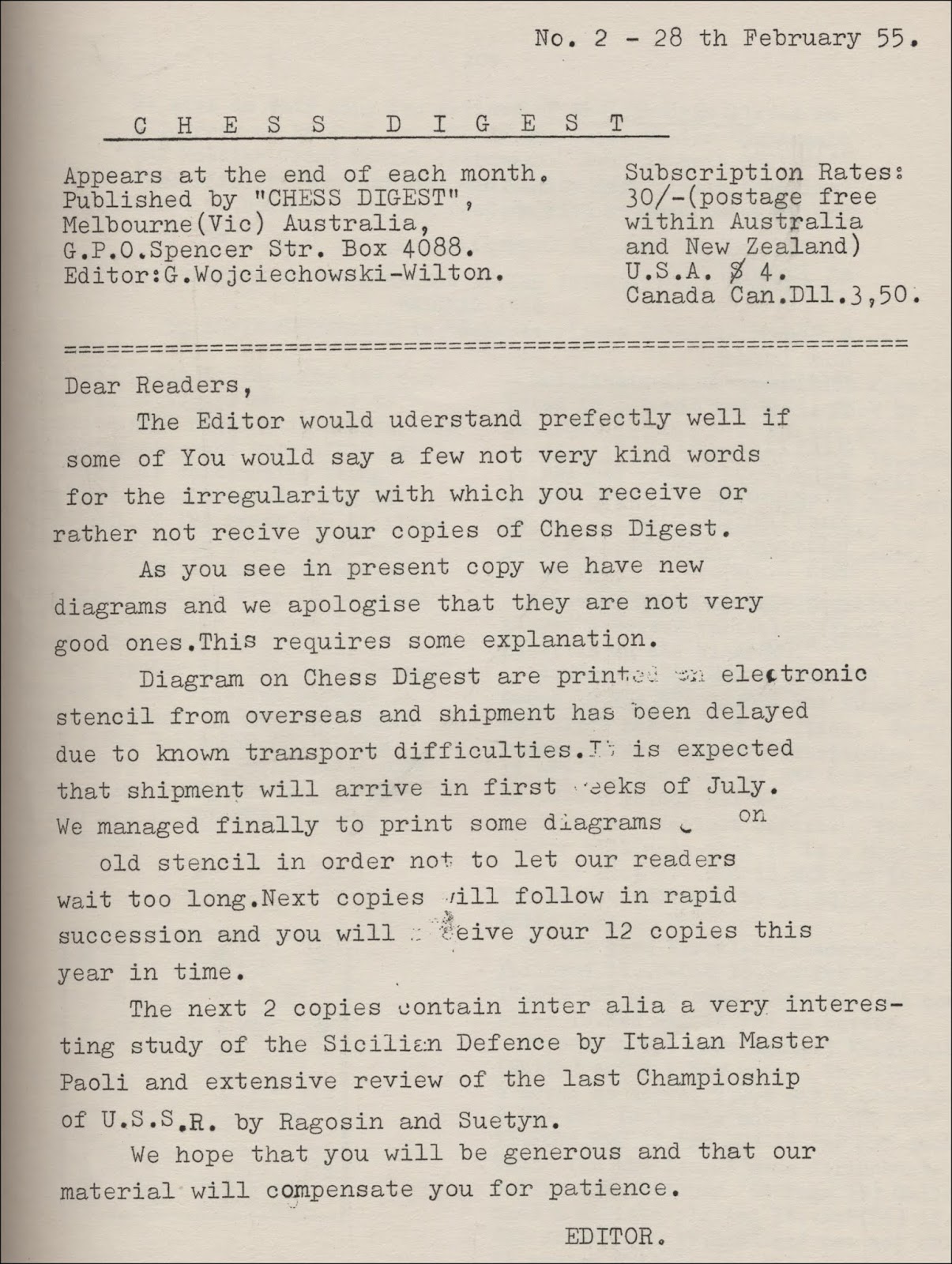
Chess Digest, edited by G. Wojciechowski-Wilton, ran for 18 numbers from October 1954 to March 1956.


The magazine was published in Melbourne, Australia and, although not recorded in Betts' Bibliography, this is listed in Di Felice's Chess Periodicals at no. 542. (Another Australian chess magazine omitted from Betts' Bibliography is the C.C.L.A. Record - see my article of 3rd October 2017)


I have volume one consisting of the first 15 numbers, from October 1954 to December 1955, which B. H. Wood had bound together.


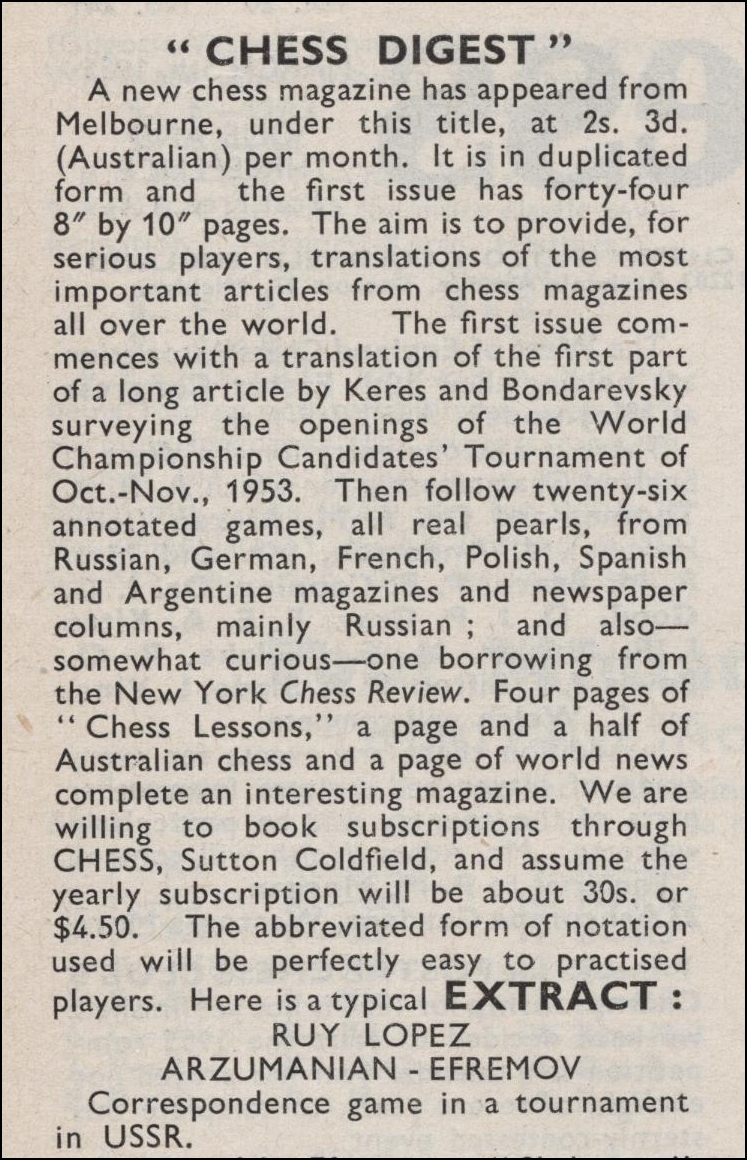
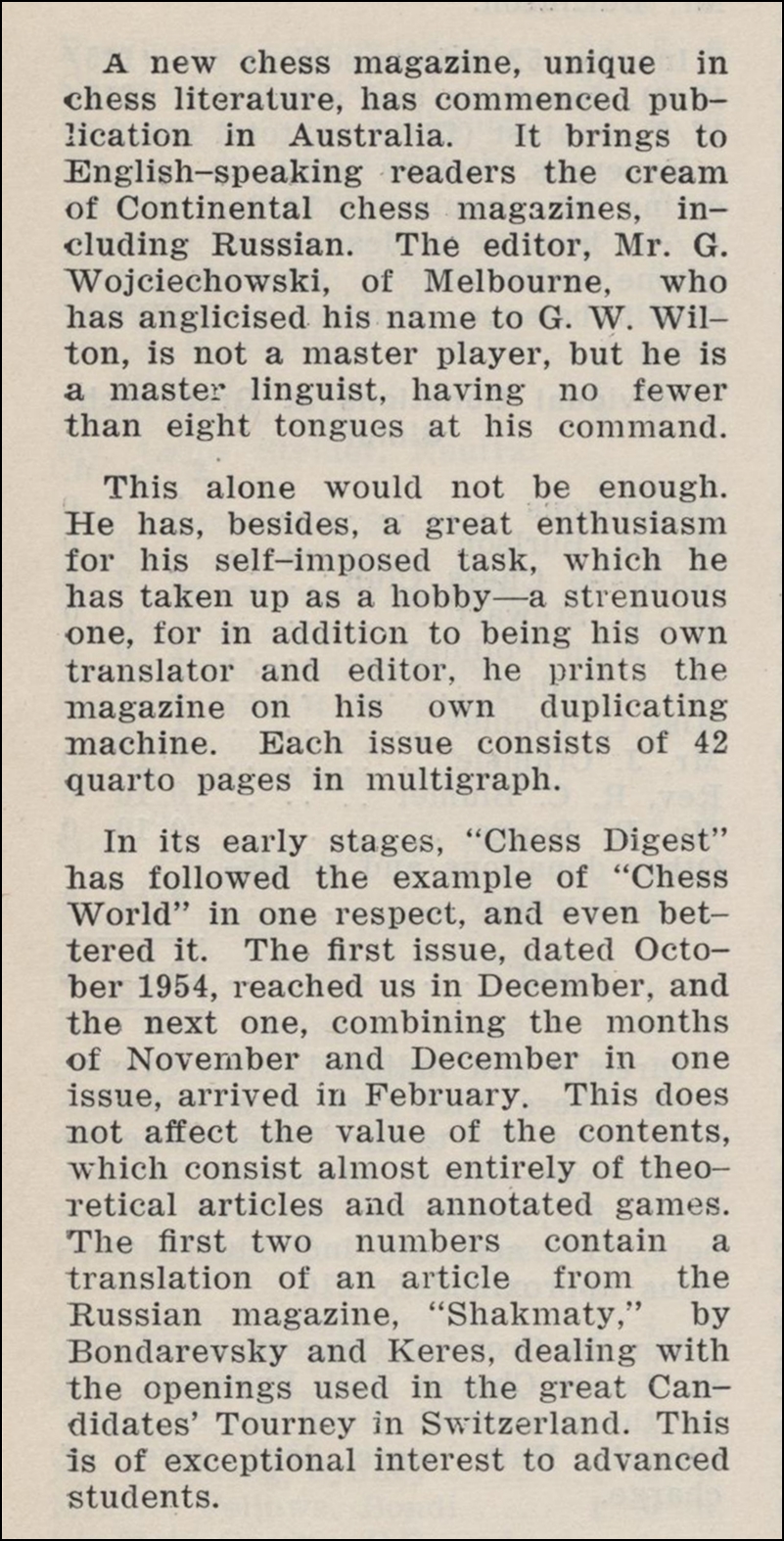
Wood reviewed the magazine in Chess for March 1955 on page 244, and C.J.S. Purdy gave a very welcoming review in his own magazine Chess World in February 1955 on page 32, even though Chess Digest became his only home-produced competitor.

Chess, March 1955, page 244


Chess World, February 1955, page 32


A large proportion of each magazine was taken up with theoretical articles and games taken from foreign chess publications, and the bulk of this was from Russian sources. Australian chess news had two or three pages at the end of each issue. Among the foreign periodicals plundered were Shahmaty v SSSR, Caïssa (West Germany), L'Échiquier de Paris, Szachy, Chess Review, El Ajedrez Espanõl; and this was in just the first issue.


Nevertheless, the editor brought to his Australian readers up-to-date games and opening theory from around the world which would probably have been otherwise unobtainable.     


                                       © Michael Clapham 2020

Monday, 23 March 2020

American Chess Magazine 1897 to 1899. Part 2.

Firstly a follow up to the previous notes on American chess periodicals in vol. I.

The American Chess Magazine, Volume II, pages 201 to 203 and pages 252 to 254 gives very detailed information on American Chess Periodicals compiled by John G. White at the request of ACM. This includes publications in the United States and also the  South American continent.


J. G. White queries whether the St Louis magazine ever appeared, but it is now in the Cleveland library, and he does not mention The Visitor or Chess Gazette of Philadelphia. 

If the print in the above scans is too small to read I can break each page into smaller segments to enlarge the print size.

Secondly, an editorial change took place from September 1899 which was not mentioned in the previous article. There was no commentary on the reasons for this in the September 1899 magazine. 


Sunday, 22 March 2020

Mortimer and Morphy

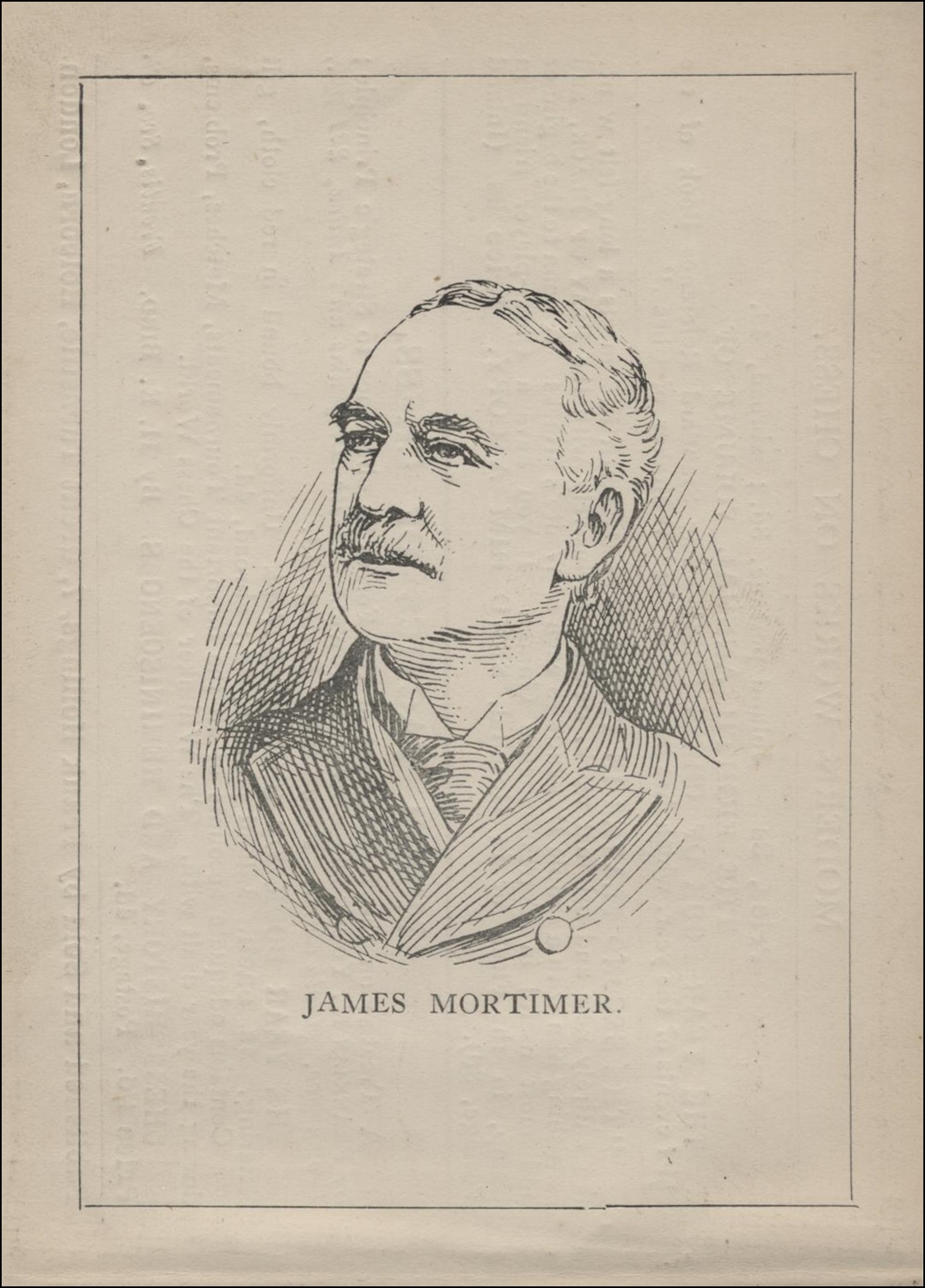
The Chess Player's Handbook and Manual of the Openings, edited by James Mortimer, London 1917.


This sixteenth edition, and twenty-seventh thousand, is an enlarged version of The Chess Player's Pocket-Book and Manual of the Openings first published in 1888. The fifteenth edition had been published in 1906 and this latest edition was published posthumously, six years after Mortimer's death in 1911.


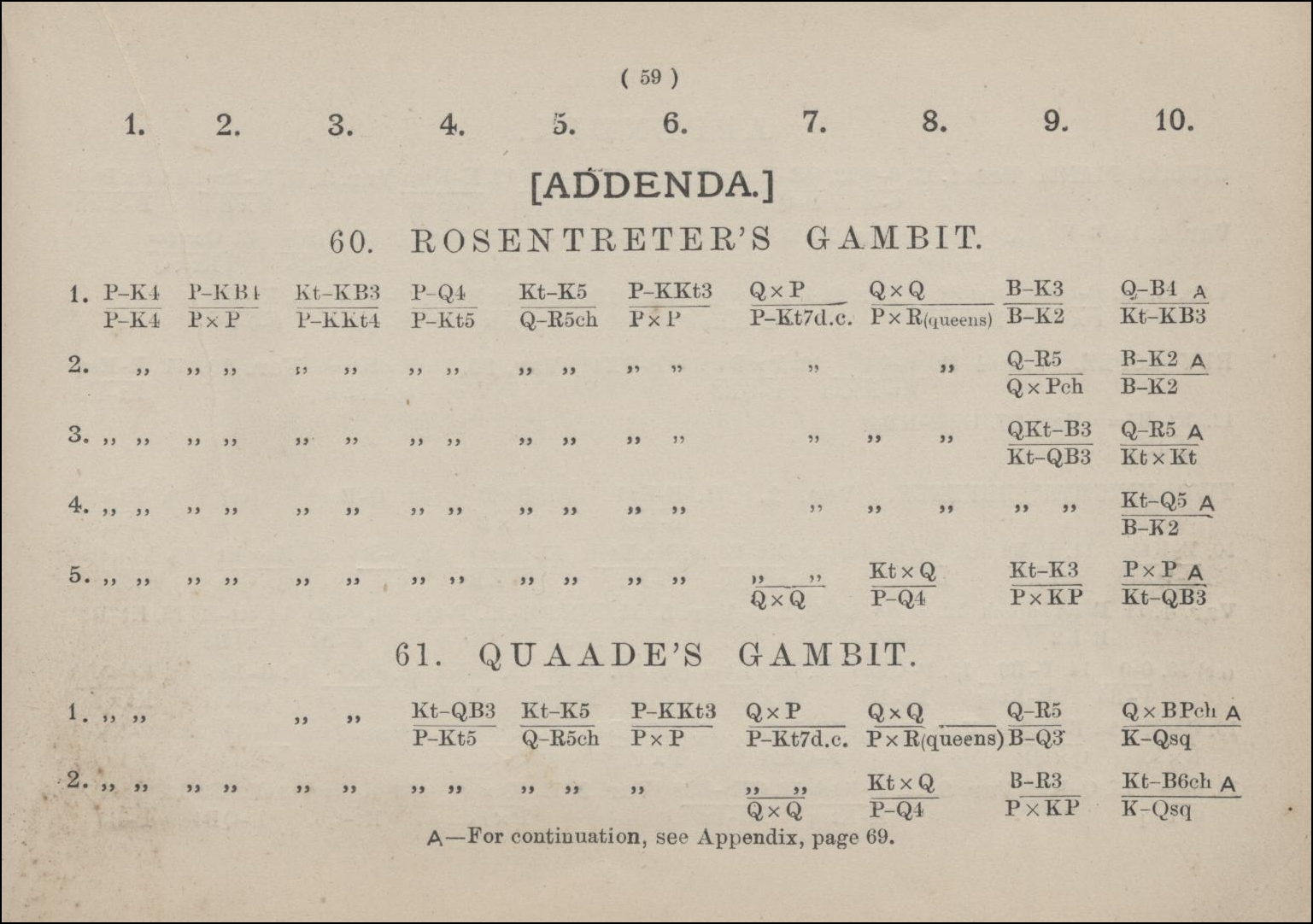
This little book contains a tabulated analysis of the openings with each line taken to 10 moves and further continuations to some lines in the Appendix.


However, the main interest lies in the Memorial Introduction giving details of Mortimer's fascinating life, an outline of which follows:

Born in Richmond, Virginia in 1833.
Resided in Paris from 1855 to 1870 as attaché to the United States Legation.
An intimate friend of Paul Morphy with whom he played many games. (Although none are recorded in the many Morphy games collections that I have checked)
Emperor Napoleon III (nephew of Napoleon Bonaparte) was another personal friend.
Moved to London in 1870 and founded the London Figaro which provided a chess column by Löwenthal and later, Steinitz.
Imprisoned following a libel case against the London Figaro.
A playwright with over 30 plays to his name, Mortimer was acquainted with many of the leading actors in England during his 40 years here.
At the age of 77 he travelled to San Sebastian for the International Tournament of 1911 as special correspondent of a leading London daily, (he was editor of the Daily Mail and Evening News). However, he was taken ill and died there on 24th February 1911.


Much more detailed information on Mortimer's life can be seen in the feature article; James Mortimer: Chessplayer and Playwright at Edward Winter's Chess Notes site.

Mortimer wrote one other chess book: The New Century Chess-Book, London 1901. A new and enlarged edition was published in 1906 with later reprints.


                ________________________________________

Morphy's Games of Chess and Frère's Problem Tournament, by Thomas Frère, New York 1859.


This is another book rushed out in the wake of Morphy's accomplishments but, as the author says in his Preface " it is simply a supply for a universal demand"
  
1859 saw the appearance of seven new works on chess in the English language, all published in America:

Science and Art of Chess, by J Monroe, New York.
The Chess Player's Instructor, by Charles Stanley, New York.
The Chess Handbook, Philadelphia. (An abridged version of Staunton's Chess Player's Handbook with new games and problems, possibly edited by Mears (Betts)).
The Book of the First American Chess Congress, by Daniel Fiske, New York.
The Exploits and Triumphs in Europe of Paul Morphy the Chess Champion, by Frederick Edge, New York. (A similar book was also published in London in the same year: Paul Morphy, the Chess Champion.)
Morphy's Games of Chess and Frère's Problem Tournament, by Thos. Frère, New York.
Morphy's Match Games, by Charles Stanley, New York.

The imprint on the reverse of the title page of Frère's book states "Entered according to Act of Congress, in the year Eighteen Hundred and Fifty-eight", but the Preface is dated January 10th 1859; this was probably the first of the books published in 1859.  


This little 144-page book has attractive blind-stamped covers and my copy has four blank leaves at each end. Frère gives a sketch of Morphy's life taken from Fiske's Chess Monthly magazines. There are 103 games with light notes but no diagrams.


The final 30 pages give 39 problems, on diagrams, from Frère's Problem Tournament followed by solutions. The problems are from a tournament conducted by Frank Leslie's Illustrated Newspaper of which Frère was chess editor. The unusual first prize, awarded to Theodore M. Brown of St. Louis, Mo.,  was "a collection of portraits of all composers who saw fit to send a single three-move problem accompanied by their likeness"


                        ________________________________________


                                             © Michael Clapham 2020

Friday, 20 March 2020

American Chess Magazine 1897 to 1899

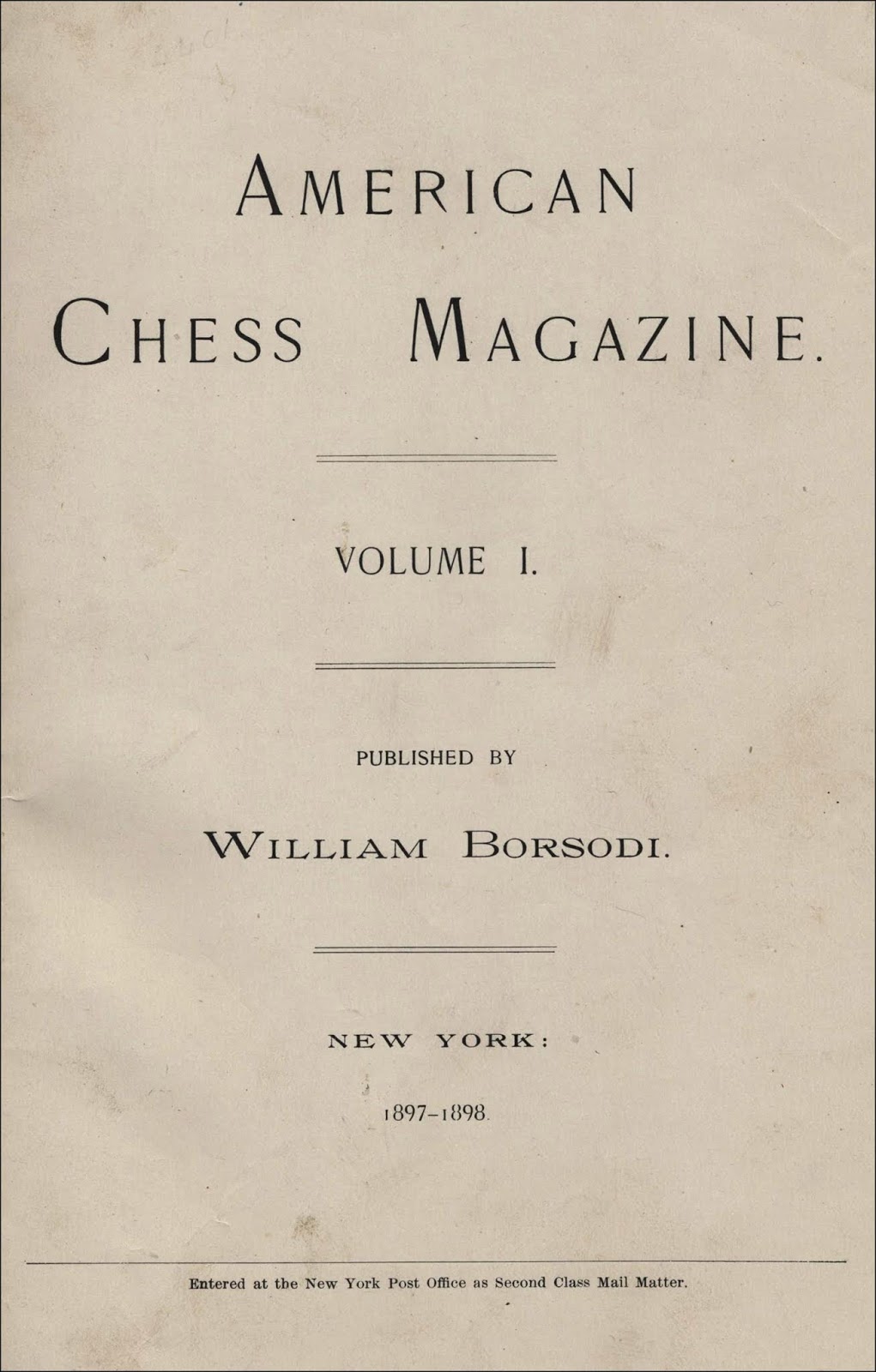
Several excellent chess magazines were published in the U.S.A. in the 19th century, including Fiske's Chess Monthly, Brentano's Chess Monthly, Steinitz's International Chess Magazine, and The Columbia Chess Chronicle, but perhaps the best of all was the American Chess Magazine published by William Borsodi in New York from June 1897 to December 1899. I will dip into this occasionally and present some of the many items of interest.


Charles Devidé was the chief editor from June to September 1897 followed by L. D. Broughton Jr. from October 1897. A. H. Bierwirth edited the final issues from September to December 1899. Other well-known chess personalities of the period co-operated in the production of the magazines:


Each issue of volume I had around 60 pages and the production standards were very high. The magazines were profusely illustrated throughout with high-quality photographs. Volume I includes 270 portraits in addition to over 70 other group photographs and illustrations, while volume II has 400 portraits! Notwithstanding the excellent quality of most of the photos, the frontispiece to volume I, a portrait of Morphy, is perhaps not his best likeness:


A few of the many wonderful photographs:

Page 72, First International Ladies Chess Congress

Page 269, Key to the above photograph


Opposite page 16
Opposite page 32


Page 149, New Yorker Staats-Zeitung Chess Cup Match


The magazines included the usual fayre of chess news from home and abroad, tournament and match reports, games, problems, correspondence chess, obituaries, book reviews etc. but, in addition, the American Chess Magazine majored in articles on chess history and literature, and included biographical details of many personalities.

An item on page 140 of volume I gave details of chess periodicals published in America, highlighting the short life span of many of them:


The Boston Chess Magazine is, no doubt, the American Chess Monthly published in Boston from 1892 to 1893 and the Washington Chess Journal is The Chess World published in Washington from January to May 1893.

The list is inaccurate, with many omissions, and a letter from J. S. D. Hopkins with additions was published on page 286.


However, this does not complete the record of American chess periodicals of the 19th century; Gino Di Felice's Chess Periodicals also lists the following:

Chess Palladium and Mathematical Sphinx, New York 1846
The Visitor, 1858. A manuscript magazine. Not in Hagedorn*
The Philidorian, Charleston 1859. Hagedorn* page 75 notes that there are no surviving original copies.
The Gambit, New York 1859. Not in Hagedorn* which covers works up to 1859.
The Chess Record, Philadelphia 1873.
Chess Gazette, Philadelphia 1882.

A note on page 344 states that the now ex-editor Charles Devidé was writing a book on modern chess openings with the assistance of Pillsbury and Showalter in America and Tarrasch, Tchigorin and Alapin abroad. This work never appeared although Devidé did publish A Memorial to William Steinitz in 1901 containing a collection of his games.

Original copies of American Chess Magazine are very scarce and even during the magazine's existence, there were repeated requests for the return of particularly hard to find issues (especially nos. 2 and 8 of volume I) so that bound volumes could be made up.  Moravian Chess of Olomouc, Czech Republic has published reprints which are useful for the textual content but the reproductions of the many photographs are particularly poor as shown below:

Left: Original edition, Right: Moravian reprint


* Benjamin Franklin and Chess in Early America by Ralph K. Hagedorn, Philadelphia 1958.


                                            © Michael Clapham 2020

Thursday, 19 March 2020

British Championships, Felixstowe 1949

The 36th British Chess Federation Congress was held in Felixstowe, Suffolk in August 1949. No tournament book was published but the first issue of The Chess Bulletin for 3rd September 1949 was headed Special Felixstowe Supplement and most of the 8 pages were devoted to a report on the Championships.


Betts' Bibliography lists this special edition under tournament publications at 25-190, and this is also included in Gino Di Felice's Chess Competitions 1824-1970, published by Moravian Chess.  This remarkable and invaluable 554-page book records over 5,000 publications relating to chess competitions.


The Chess Bulletin incorporated The London Chess Bulletin and The Midland Chess Bulletin, which had already incorporated the Warwickshire Chess Bulletin.

Felixstowe 1949 was the first British Championship to use the Swiss pairing system, enabling 32 players to take part instead of the usual 12 for an all-play-all tournament. The winner was Harry Golombek who thus regained his title, and Miss Eileen Tranmer won the Ladies Championship with a perfect score of 11 out of 11.

The group photograph on the front of The Chess Bulletin is also included on page 3 of Chess for October 1949 with a key to the 46 players and officials. Golombek is standing on the extreme left and Miss Tranmer is seated at the end of the front row.


The British Chess Magazine included extensive coverage of the congress on pages 293 to 312 of its September 1949 issue but without any photos. In fact, there is not a single photograph or illustration in The British Chess Magazine throughout the whole of 1949. (Compare with the American Chess Magazine of 1897 to 1899 in the next article.)

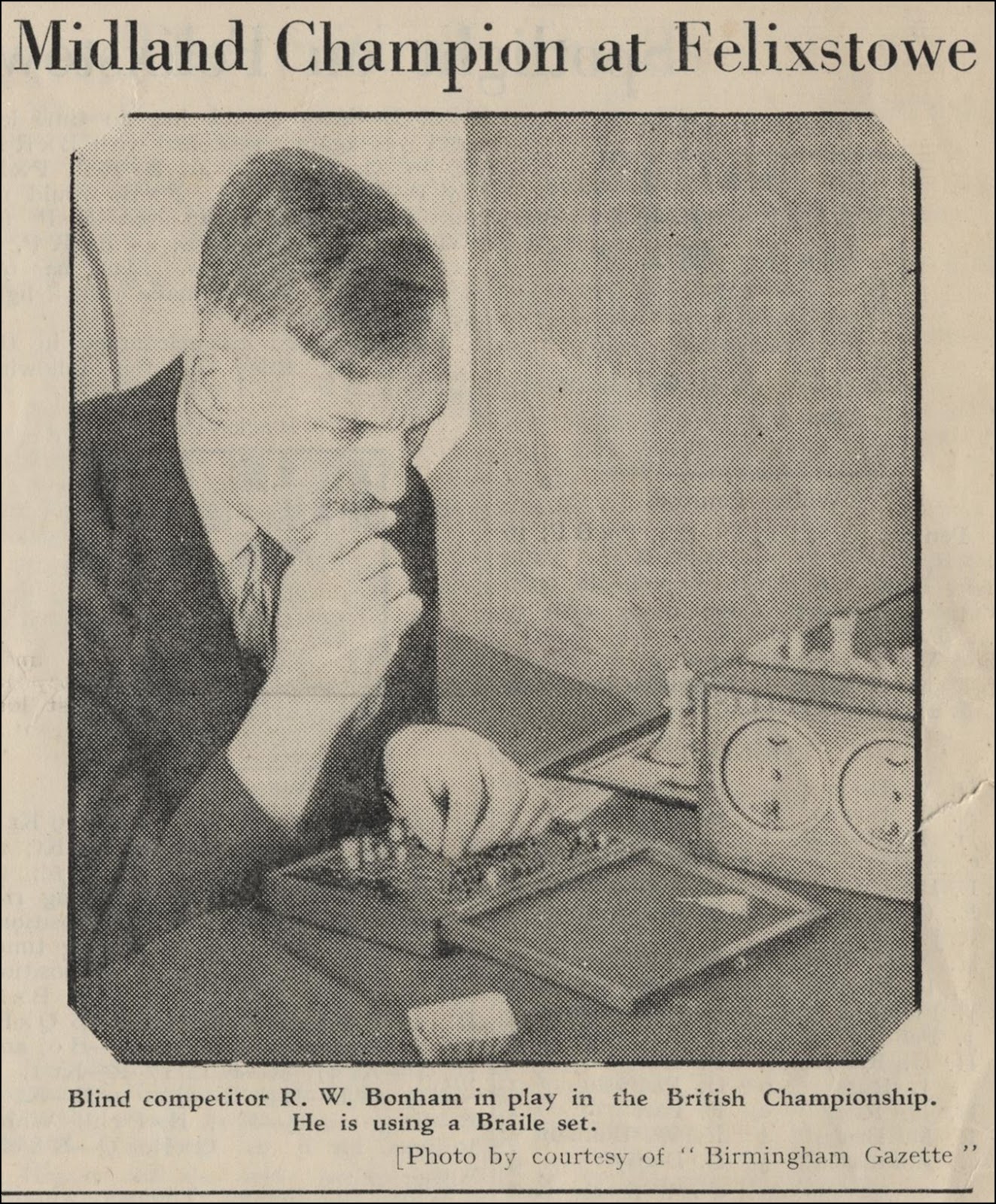
The Chess Bulletin included one other photograph in its special issue; a shot of R. W. Bonham pondering over the position with his Braille chess set.


Reginald Bonham was a master at the Royal Worcester College for the Blind for many years and co-author with R. D. Wormald of Chess Questions Answered, London 1945 and More Chess Questions Answered, London 1948. 


                                       © Michael Clapham 2020

Wednesday, 18 March 2020

Periodicals

With all major sports postponed or cancelled, chess matches off, running groups and Parkruns cancelled, and I shouldn't even go to the pub, there is little else to do except play with my chess books. To start with I have rearranged some of the periodicals and it is very satisfying to see them organised in colour coordinated rows:


On show are the following; Shelf 1:


The Philidorian, 1838. The Chess Player reprint.
The Chess Player's Chronicle, 1841 to 1849 and a few later volumes.
The British Chess Review, 1853 to 1854, complete.
The Chess Player, 1851 to 1853, complete.
The Chess Monthly, 1858, volume I only of V.
The Chess World, 1865 to 1868, Volumes I to III, lacking volume IV.
Brentano's Chess Monthly, May 1881 to August-September 1882, complete.
The City of London Chess Magazine, 1874 to January 1876, lacking final issue.

Shelf 2:


Westminster Papers, 1868 to 1879, complete.
The Chess Monthly, 1879 to 1893, lacking volumes 13, 15 to 17.
The Columbia Chess Chronicle, July 1887 to June 1888. Volumes I & II of V.
American Chess Magazine, 1897 to 1899. Volumes I & II, lacking III.


Shelf 3:


Chess Player's Annual and Club Directory, 1882 to 1893/94, 4 of the 6 editions.
The Chess Amateur, 1906 to 1930 complete.


Shelf 4:


The Year-Book of Chess, 1907 to 1915/16, complete.
British Chess Magazine Chess Annual, 1915, 1916, 1926, complete.
Chess World, 1946 to 1966, volumes 1 to 21, lacking volume 22 for 1967.
The International Chess Magazine, 1885 to 1891, Olms reprint.
The Social Chess Quarterly, 1930 to 1936, complete.

Shelves 5 and 6:


Chess, 1935 to 1997, volumes 1 to 62.


I will try to post something on most days for a while, even if it's just a couple of pictures and a few words.