Thursday, 16 April 2020

Chess and Draughts

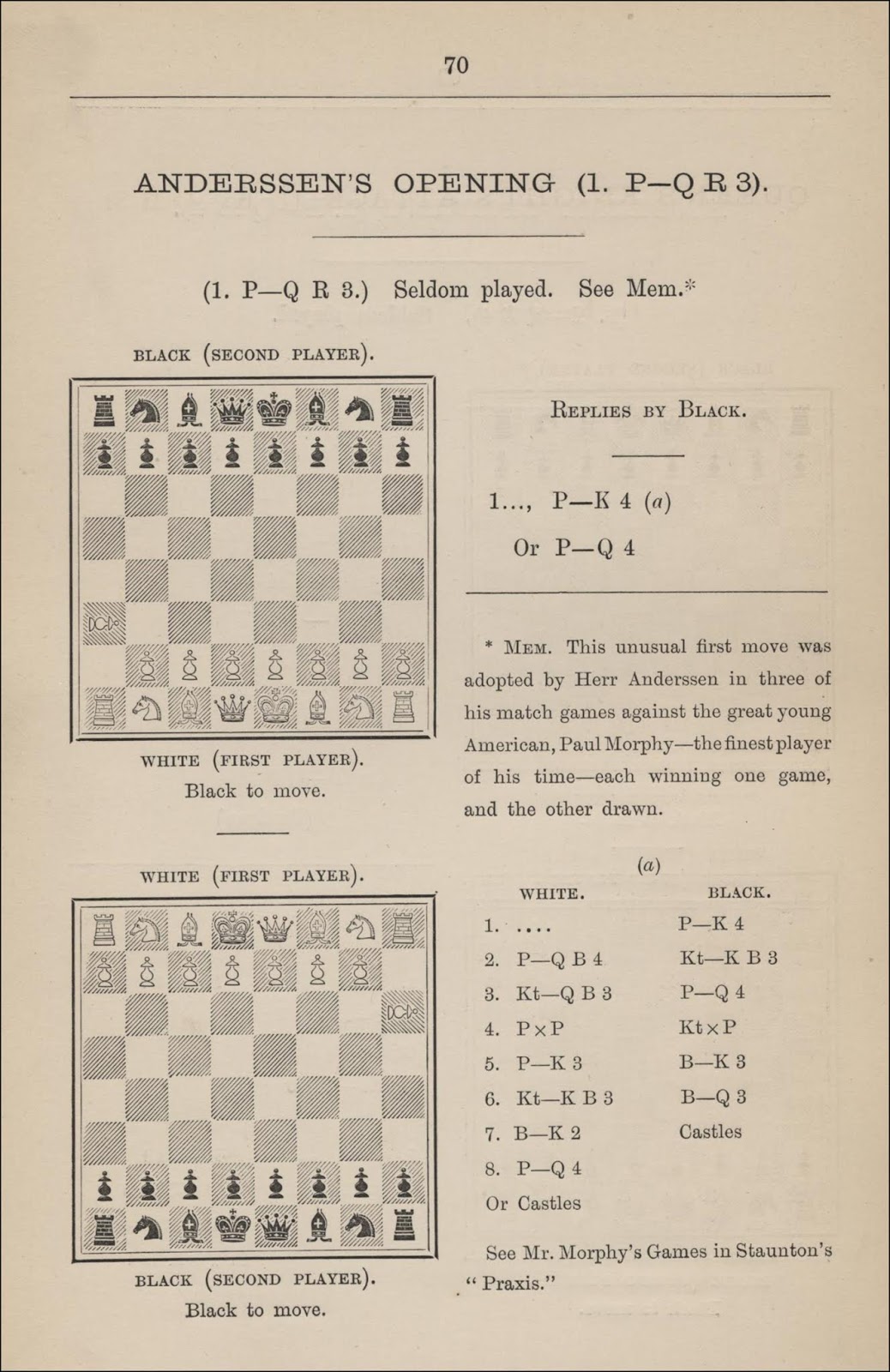
Many authors have combined the teaching of chess and draughts in one book. Here are brief details of a few of these in the English language:

Chess: its Theory and Practice; to which is added a Chapter on Draughts, by Captain Crawley, London 1858. Betts 10-11


This book by Captain Crawley, pseudonym of George Frederick Pardon, went through thirteen editions up to 1880, but the first edition of 1858 is particularly hard to find. Douglas Betts could find nothing earlier than the 4th edition for his Bibliography, and the LN catalogue of 1955 also only lists the 4th edition onwards. (Probably the book examined by Betts). The Koninklijke Bibliotheek in The Hague still does not have the first edition of this book.

Betts's Bibliography states that the 4th edition has 191 pages and includes 32 games; the first edition has 180 pages and 31 chess games and was one of the first books to include games by Morphy.

The examination of chess takes up 163 pages while the final chapter on draughts is just 17 pages long.

Captain Crawley's book was substantially revised and brought up to date in 1876 for the 10th edition onwards and the treatise on draughts was entirely new. Chess 156 pages, draughts 32 pages.

_______________________________________________________________


Everybody's Guide to Chess and Draughts, by Henry Peachey, London 1896. Betts 10-57.


The author devotes 208 pages to chess but only 18 to draughts.

The book was reprinted in 1899 by a new publisher W. R. Russell.

 
In addition to the usual history/rules/instructions/openings/endings/problems, the chess section of this book includes a chapter on the author's personal observations of contemporary chess masters, taking as his subjects fifteen of the leading players from the Hastings Chess Tournament of 1895.
    
___________________________________________________


An Elementary Guide to the Scientific Games of Draughts and Chess, by Albert Belasco, London 1912. Betts 10-83.


The first six editions of this work included draughts only. Seven of the 38 pages in this book are full-page adverts, page one is the title page, leaving 18 pages for draughts and 12 for chess. The book includes brief biographies of Emanual Lasker and Joseph Blackburne, and the draughts players James Wyllie and Alfred Jordan.

In 1916 Belasco brought out a revised work; Chess & Draughts: A Complete Guide, and this was published in at least 38 editions into the 1960s with updated material. The 60 pages were divided approximately equally between draughts and chess.  


___________________________________________________

A Complete Guide to the Games of Checkers and Chess, by Maxim La Roux, Baltimore 1916. Betts 10-93.


Maxim La Roux's book has a heavy emphasis on the game of draughts which is discussed in the first 95 pages, with coverage of Polish, Spanish, Italian and Turkish draughts, in addition to the standard game. The final 32 pages deal with chess.

___________________________________________________


Chess and Checkers: the way to Mastership, by Edward Lasker, New York 1918. Betts 10-97.


The extensive chess tutorial occupies the first 222 pages, while the section on checkers covers the final 62 pages and was written in collaboration with Alfred Jordan, world champion from 1912 to 1917. 

_______________________________________________________________


Chess and Draughts: How to enjoy them, by Charles Platt, London 1933. Betts 10-131. Chess - pages 1 to 114, draughts - pages 115 to 130.


Note the randomly placed draughts pieces which should all be on squares of the same colour.

This book was re-issued in 1941 with minor revisions and a new title: Complete Guide to Chess and Draughts. In this edition, chess takes up 107 of the 125 pages.


Thanks to Owen and Kathy Hindle for the image of Chess and Draughts: How to Enjoy them.
 _______________________________________________________________

Other books combining chess and draughts include the following: (up to 1950)

The Whole Art of Chess & Draughts (Draughts and Chess for the Millions), London circa 1844.

Chess & Draughts Made Easy, by J. Bishop, London circa 1855.

The Hand-book of Chess and Draughts, by R. Wormald, London 1866. 

How to Play Checkers and Chess by S. Walker, Cleveland circa 1920s.

Guide to Chess and Checkers: A Complete Course of Instruction for Beginners, by D. Mitchell and L. Held, Cleveland 1941. 

___________________________________________________


                                          © Michael Clapham 2020


Monday, 13 April 2020

J. B. of Bridport


Chess Strategy. A Collection of the Most Beautiful Chess Problems Composed by "J.B., of Bridport", London 1865. 


Within just over a decade, John Brown (who styled himself J. B. of Bridport to avoid confusion with other chess composers of the same name), became a prominent, and even pre-eminent, composer of chess problems, and his compositions were regularly featured in the chess periodicals of the period. Staunton included over 100 of Brown's problems in his Illustrated London News columns.   

Brown died of tuberculosis aged just 36 on 17th November 1863, and 16 months later a collection of his best problems was published, primarily for the benefit of his wife and children. The book was one of the first devoted to the problems of an individual composer; Josef Kling's The Chess Euclid (1849) and Robert Wormald's The Chess Openings (1864), which includes 50 of the author's problems, being other early examples, although neither was dedicated solely to chess problems.

Staunton was instrumental in the conception of Chess Strategy, having access to so many of Brown's compositions, but the main task of collecting, editing and preparing the material for publication was undertaken by Frederick Rainger who had edited a chess column in the Norfolk News from 1859 to 1863. However, Rainger's considerable efforts were not acknowledged in the Preface to Chess Strategy, a matter raised by I. O. Howard Taylor on page vi of his book Chess Skirmishes, Norwich 1889. 


Chess Skirmishes, page vi

(See also Eminent Victorian Chess Players by Tim Harding, page 72, and the same author's British Chess Literature to 1914, pages 259 and 327).

Chess Strategy includes 174 problems, arranged on diagrams, two to a page, with solutions at the end. The problems range from two-movers to five-movers with over two-thirds being three-movers.


A few problems were repeated in error; nos. 73 and 77 are identical, as are nos. 39 and 132. 72 is a mirrored version of 32, and 102 is 35 mirrored and translated.


     ___________________________________________________________


Nearly 150 years after the death of John Brown, his life and chess career were revisited by Brian Gosling in John Brown: The Forgotten Chess Composer?, Leicester 2011.


This extensively researched work (and very reasonably priced at just £10), includes substantial biographical information on John Brown and the history of his family in Bridport in the West Country of England. The book also constitutes an easy introduction to the chess problem composer's art and a brief history of problem composition in the 19th century. The author traces Brown's development as a problem composer and presents 50 problems from Chess Strategy with more detailed solutions and explanations than were included in the original collection.


Gosling's book opens with a photographic portrait by Lewis Carroll and closes with an item on Lewis Carroll's appearance at the Redcar Chess Tournament in 1866. John Brown and his contemporary Lewis Carroll had a number of similarities including their religious vocations and enjoyment of chess problems. Lewis Carroll had a copy of Chess Strategy in his library which he probably purchased at the Redcar Chess Tournament in support of Brown's family.  


The book has the following poor image of John Brown which may well be the only known portrait of him:


This is taken from opposite page 28 of The Chess Problem by H. Weenink, Stroud 1926, an invaluable work on the history of chess problems and problemists. This, in turn, was taken from the photographic chess board; Chess Champions of England, published by H. F. L. Meyer in 1871.

The Chess Problem by H. Weenink, opp. page 28.


Brian Gosling devotes a chapter to Howard Staunton and the ILN, highlighting Staunton's popularisation of chess problems through his column in the widely circulated Illustrated London News and, in particular, his promotion of the compositions of John Brown of which over 100 appeared between 1853 and 1863.  This was a major factor in developing the reputation of Brown as a problemist.

Staunton included a brief mention of Brown's death in his column for 28th November 1863 and published a long review of Chess Strategy in November 1865.  A two-page review of Chess Strategy had earlier appeared in The Chess World, May 1865, pages 70-71. Probably written by Staunton, the unnamed editor of this periodical, the review affirms that the book "has been produced under the supervision of an eminent English amateur". Was he referring to himself or Rainger? 

The Chess World, May 1865 page 71.


Gosling does not mention F. G. Rainger in his book and was seemingly unaware of the latter's participation in Chess Strategy. Chess Skirmishes is not listed in the fairly extensive bibliography of 54 chess works. 

The author summarises his researches into John Brown as follows:


The book has six Appendices beginning with The Problems of J. B. by J. Beasley.
This reproduces a lecture given to the British Chess Problem Society by John Beasley in November 1990 and includes 25 problems taken from Chess Strategy, although 14 of these are already included in Gosling's choice of 50. 

There are a few historical inaccuracies, and the odd typographical error, but the book is generally very well researched and produced. Gosling gives an enjoyable account of the life and family of J.B. of Bridport, his influence on the art of chess problem composition and the general development of chess problems in the 19th century.


                                                      © Michael Clapham 2020


Sunday, 5 April 2020

American Chess Magazine 1897-1899. Part 5

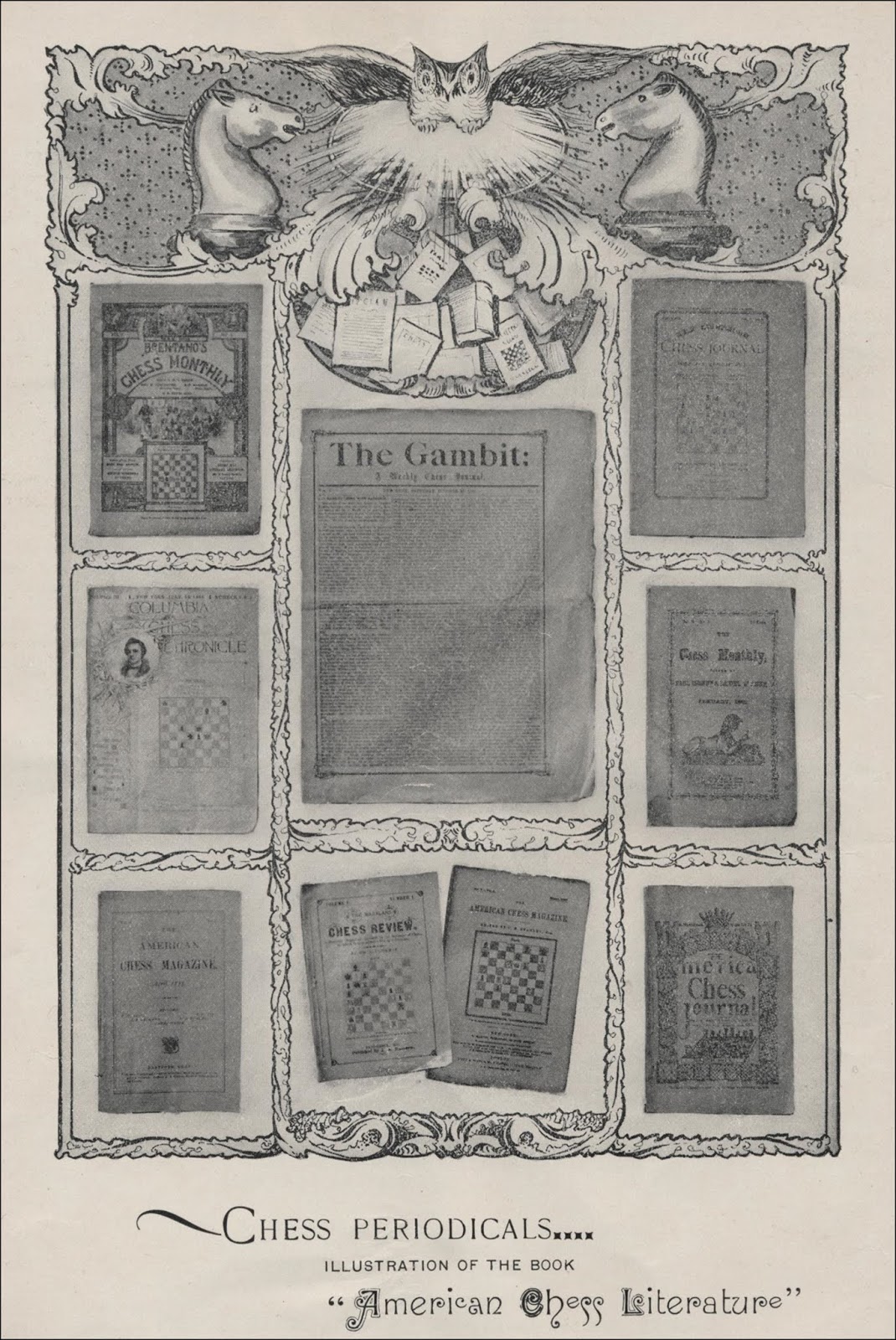
Volume II of American Chess Magazine has a frontispiece illustration on page 2 which, unfortunately, has not been included in the Moravian Chess reprint. This illustration, showing the covers of nine American chess periodicals, is listed in the index for volume II and was intended for a forthcoming book on American Chess Literature. Even more unfortunately, that tantalising tome was never published.


An announcement of this book appeared on page 36 of the July 1898 magazine:


The promised illustrations did not appear and there was no further mention of this potentially extremely interesting work.  

        ________________________________________________________

Another planned book that never saw the light of day was a second edition of Chess Harmonies by Walter Pulitzer. The following full-page advert appeared on the reverse of the final page of the Index to volume I; again this is absent from the Moravian Chess reprint:


A second edition of Chess Harmonies had been touted in the very first issue of American Chess Magazine in June 1897 on page 15:


... and the July 1898 magazine included the following notice in the Literature section on page 28:


                                     ©  Michael Clapham 2020

Friday, 3 April 2020

Double Diagrams in the Chess Openings by Thomas Long

I wrote about Thomas Long's four 19th century books on the chess openings on 17th March 2016 and included illustrations from Key to the Chess Openings and Positions in the Chess Openings.


I have now acquired Double Diagrams in the Chess Openings, Huddersfield 1894, which is much the scarcest of Long's books.


This book has 92 very thick pages and, naturally, was written to supply a long-felt want; in this case to show the openings from both sides of the board on one page. 


Long ends his Preface by acknowledging the various sources consulted for this book:


The author employs his unique method of highlighting the last move played by turning the piece moved on its side. 


The material is divided into King's pawn and Queen's pawn openings and several very obscure lines are included such as the Fyfe Gambit, Fraser-Ensor Gambit, Prince Ouroussof's Attack and Van't Kruyz Opening.


                                      © Michael Clapham 2020

Thursday, 2 April 2020

American Chess Magazine 1897-1899. Part 4.

The following American chess editors were discussed in Volume II of American Chess Magazine in 1898-1899:

VI. Hermann Helms. August 1898, page 83.

This brief biography of Helms, who was born in 1870 and crowned Dean of American Chess in 1943, was written very early in his editorial career which had commenced in 1893 as editor of the chess department of the Brooklyn Daily Eagle. His journalistic activities continued until the 1950s when his column in the Eagle ended in 1955 and his editorship of the American Chess Bulletin ceased in 1956, although he continued to publish that periodical until he died in 1963. 


Emil Kemeny. October 1898, page 166.

Kemeny was born in Budapest where he also ended his days, but during his years in America, he became one of the most respected chess editors. Following on from the Philadelphia Ledger (Public Ledger) mentioned in this notice, Kemeny conducted the chess departments in the Chicago Tribune, New York Sun and North American. He also edited and published the short-lived American Chess Weekly (1902-1903), which produced a special series on the Monte Carlo Tournament of 1903. 


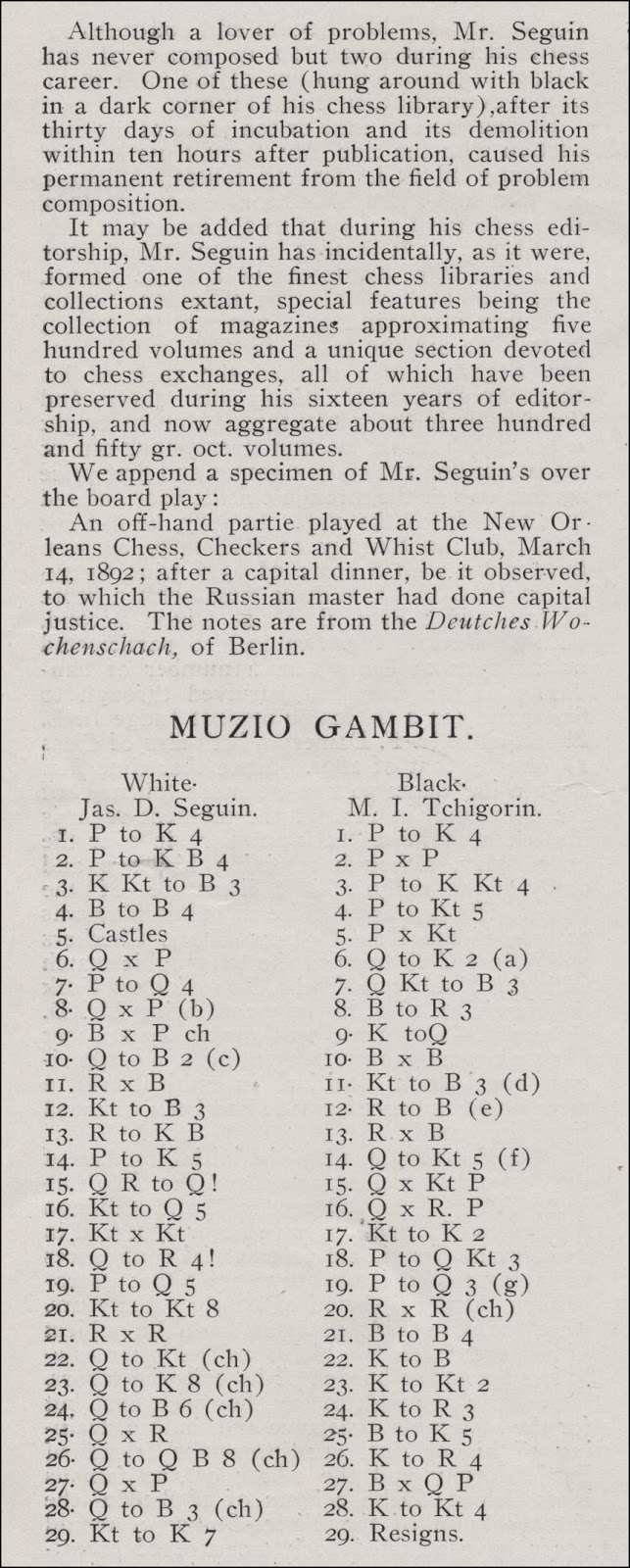
James D. Séguin. April 1899, page 437.

By far the longest of this series of notices on American chess editors, and the only one to include a game, featured James DeBenneville Séguin from New Orleans. Séguin edited the chess column of the New Orleans Times-Democrat (jointly with Morphy's friend Charles Maurian for the first few years), but I can find no other journalistic activities. He amassed one of the finest chess libraries, taking advantage of many magazine exchanges while editing his newspaper column.


A particularly useful feature of Jeremy Gaige's Chess Personalia is the list of sources for each entry. However, Gaige does not list the American Chess Magazine biographies for Hazeltine, Hervey and Reichhelm, but does record the ACM sources for the last five editors in this series on American chess editors.


                                   © Michael Clapham 2020

Wednesday, 1 April 2020
American Chess Magazine 1897-1899. Part 3.

Borsodi's American Chess Magazine published the following series of articles on American Chess Editors :

I. Miron J. Hazeltine. June 1897, page 7, (portrait opposite page 16).

The article notes that Hazeltine was co-editor with D.W.Fiske of volume I of Chess Monthly. This is not recorded in the main bibliographical works but this is confirmed, for example, on page 288 of Chess Monthly for September 1857, and also on the title page of Hazeltine's book Brevity and Brilliance in Chess, New York 1866.  Furthermore, Hazeltine is credited with compiling the practical part of Marache's Manual of Chess, New York 1866, although that work does not mention his contribution. 

Hazeltine had the finest collection of chess books in New England.


II. Daniel E. Hervey. July 1897, page 79. (Portrait on page 75)


III. Gustave Reichhelm. September 1897, page 208.

"As a writer Reichhelm is unique: his line of thought is most original and his style odd yet fascinating. He is the Carlyle among chess writers".


IV. John Galbraith. February 1898, page 525.

Galbraith was a great admirer of Staunton, declaring: "He had his faults, like the rest of weak humanity, but no unprejudiced person will deny that English chess is more indebted to him than to all other authorities put together".


 V. Hartwig Cassel. April-May 1898, page 621.


Three more chess editors were featured in volume II of American Chess Magazine and I will include these next time.

                                   
                                       © Michael Clapham 2020