Saturday, 28 March 2020

Soviet Chess Chronicle

Having recently praised Di Felice's bibliographical work: Chess Competitions 1824-1970, which gives details of over 5,000 publications on chess competitions, I have just discovered a couple of omissions. This is inevitable in a book of this nature.

Soviet Chess Chronicle (Betts 7-100), published by Chess Bureau of VOKS from 1943 to July 1946, was the English Language edition of Sovetskaya Shakhmatnaya Kronika. This periodical specialised in giving reports on Russian tournaments and at least two of the issues were dedicated to specific events.


The double issue 9-10 for September and October 1945 devoted 32 of its 33 pages to the USSR v USA Radio Match held from 1st to 4th September 1945. Chess Competitions records no English language publications on this event apart from a pre-match publicity release and souvenir program (2946.3 and 2946.5).


This issue of Soviet Chess Chronicle has 16 pages of commentary on the match, including the views of all 20 players, and gives all 20 games, extensively annotated by David Bronstein and Alexander Konstantinopolsky. There are also 14 photographs from both the Moscow and New York ends of the event together with portraits of all of the players.  


Next time, a special issue on the Anglo-Soviet Radio Chess Match. 

                                    © Michael Clapham 2020

Friday, 27 March 2020

Sotheby's Rimington Wilson Catalogue


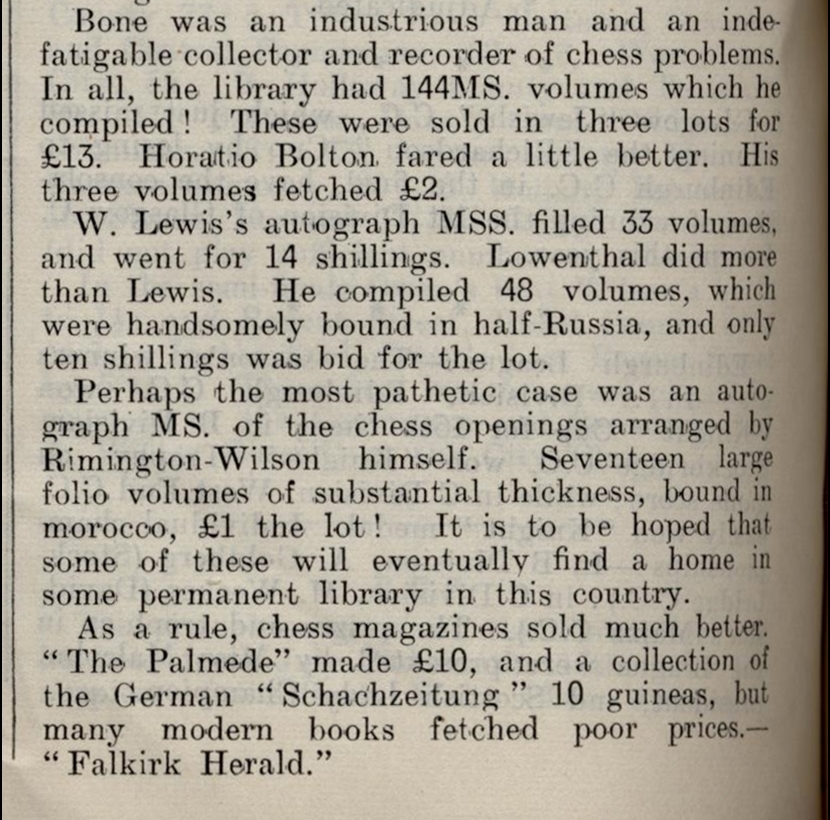
John Keeble contributed the following reports on this auction to the Falkirk Herald which were subsequently published in The Chess Amateur:


The Chess Amateur, March 1928, page 171


The Chess Amateur, April 1928, pages 207-208


The Chess Amateur, May 1928, page 240 


 The British Chess Magazine also reported on this sale as follows:


BCM, April 1928, Page 154

Thursday, 26 March 2020

Quaritch's Rimington Wilson catalogue


The renowned chess library of J. W. Rimington Wilson was sold by Sotheby and Co., London, in February 1928, more than fifty years after his death, having been maintained and enlarged by his son R. H. Rimington Wilson during this period.  The London book-dealer Bernard Quaritch acquired a large proportion of the lots on offer and subsequently issued what is probably the most important catalogue of chess works ever offered by a bookseller.


The 96-page Catalogue has 1,657 entries with numerous manuscripts and other unique items, along with many of the rarest chess books. The great majority of these items were on sale at prices that, today, seem just buttons; almost 1,200 items were priced at under £1, including many that are now completely unobtainable.


I am not going to comment now on the endless treasures in this catalogue but I set out below the 20 most expensive chess books listed. This does not include manuscripts, runs of periodicals or non-chess items. The list is in ascending order and shows the prices in pounds, shillings and pence. Most of the prices are in guineas; 1 guinea = 1 pound and 1 shilling; the shilling being the equivalent of today's buyer's premium.


The most remarkable feature of this list is the extraordinary price of Rowbothum's work. The figure of £180 seems almost to be an error when compared to the other prices. Was a Rowbothum worth more than ten times the cost of a Damiano, Ruy Lopez or Gianutio in the 1920s?  

Although Quaritch gave a detailed entry for this book there is no mention of its rarity or exceptional value. 

The price was seemingly correct; two Rowbothums were sold at Sotheby's sale of the Rimington Wilson library, for £56 and £31. Quaritch no doubt purchased one of these and added a hefty mark-up. Another buyer at the Sotheby sale was the London bookseller Maggs Bros. and they probably purchased the other Rowbothum. The following appeared in their 428 page catalogue no. 511 issued in 1928:


John Keeble furnished a number of reports on the Sotheby sale to the Falkirk Herald and these were also published in The Chess Amateur. I will reproduce these in the next article.

The Quaritch Catalogue, which, surprisingly, is not recorded in Betts' Bibliography, has become a very collectable and expensive item itself, whereas it was originally handed out for free as this advert in The Chess Amateur for October 1929 shows:


Finally, there is one, even more expensive, book in the Quaritch Catalogue but this is not a chess work:


The eye-watering price puts the Rowbothum well and truly in the shade.


                                         © Michael Clapham 2020

Tuesday, 24 March 2020

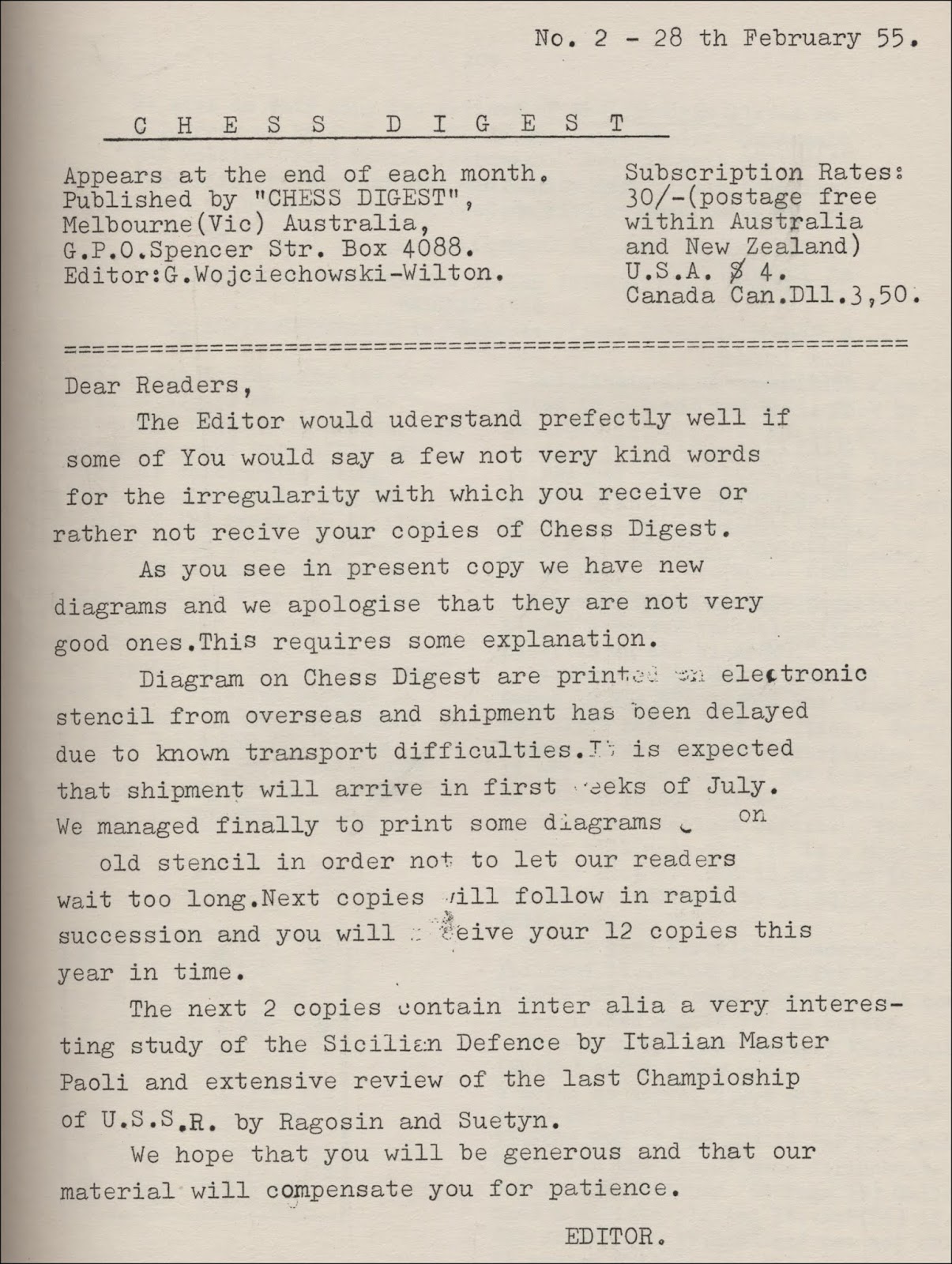
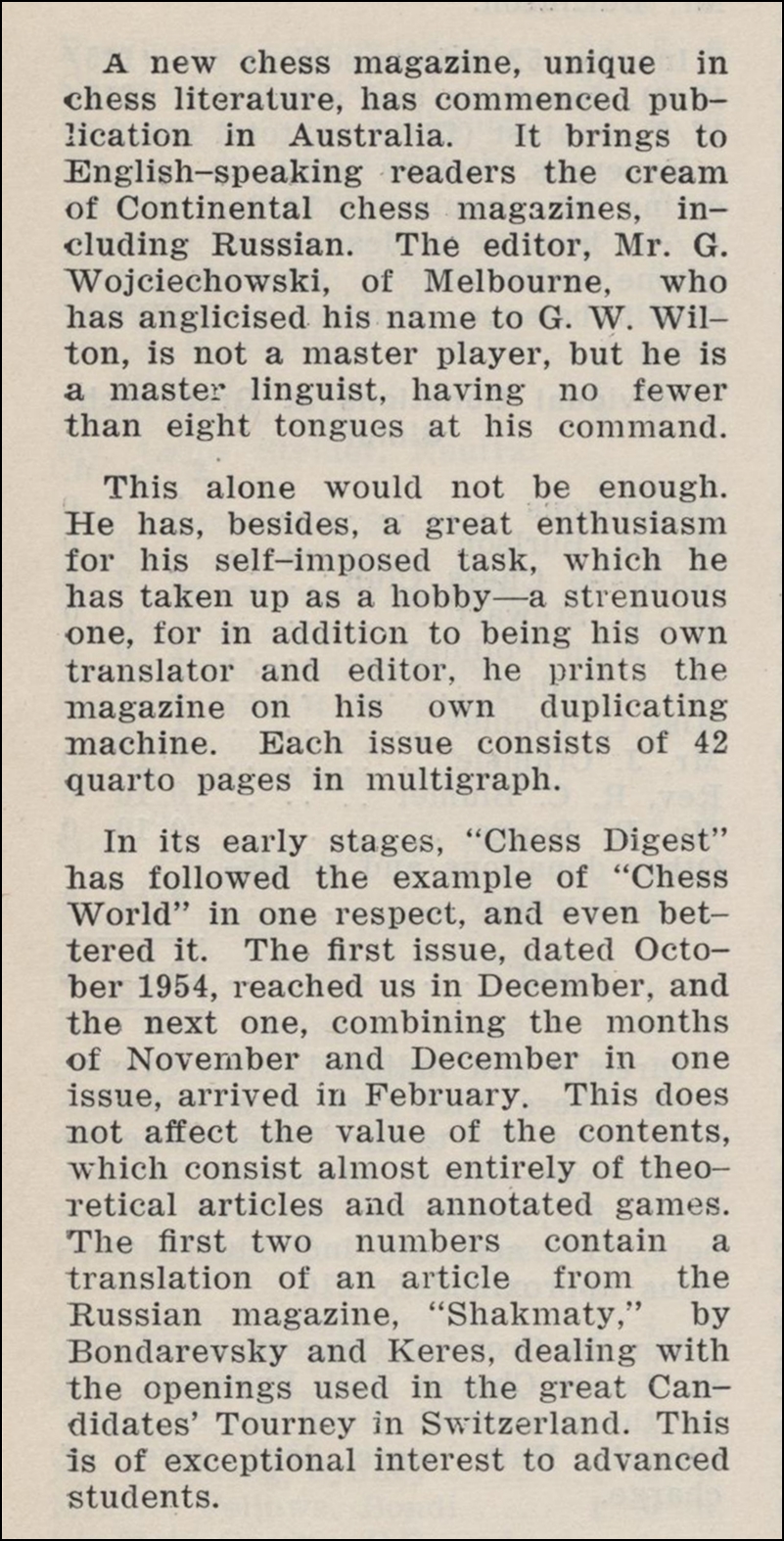
Chess Digest, Melbourne, Australia

Chess Digest, edited by G. Wojciechowski-Wilton, ran for 18 numbers from October 1954 to March 1956.


The magazine was published in Melbourne, Australia and, although not recorded in Betts' Bibliography, this is listed in Di Felice's Chess Periodicals at no. 542. (Another Australian chess magazine omitted from Betts' Bibliography is the C.C.L.A. Record - see my article of 3rd October 2017)


I have volume one consisting of the first 15 numbers, from October 1954 to December 1955, which B. H. Wood had bound together.


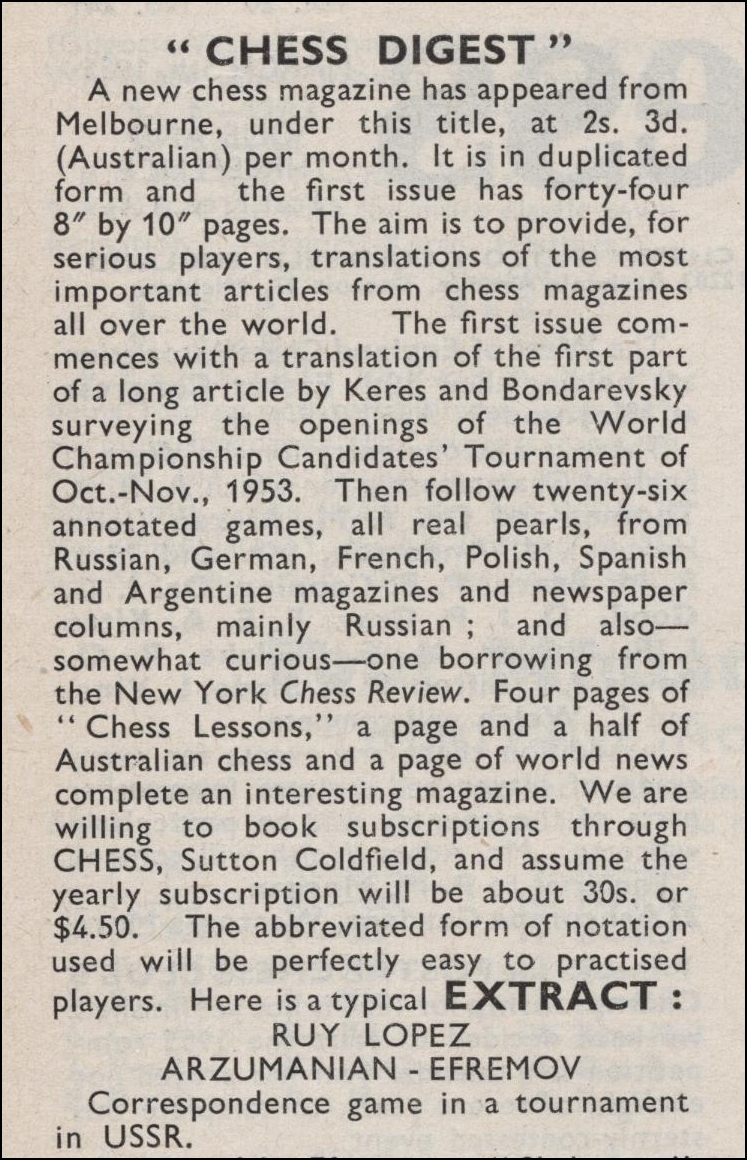
Wood reviewed the magazine in Chess for March 1955 on page 244, and C.J.S. Purdy gave a very welcoming review in his own magazine Chess World in February 1955 on page 32, even though Chess Digest became his only home-produced competitor.

Chess, March 1955, page 244


Chess World, February 1955, page 32


A large proportion of each magazine was taken up with theoretical articles and games taken from foreign chess publications, and the bulk of this was from Russian sources. Australian chess news had two or three pages at the end of each issue. Among the foreign periodicals plundered were Shahmaty v SSSR, Caïssa (West Germany), L'Échiquier de Paris, Szachy, Chess Review, El Ajedrez Espanõl; and this was in just the first issue.


Nevertheless, the editor brought to his Australian readers up-to-date games and opening theory from around the world which would probably have been otherwise unobtainable.     


                                       © Michael Clapham 2020

Monday, 23 March 2020
American Chess Magazine 1897 to 1899. Part 2.

Firstly a follow up to the previous notes on American chess periodicals in vol. I.

The American Chess Magazine, Volume II, pages 201 to 203 and pages 252 to 254 gives very detailed information on American Chess Periodicals compiled by John G. White at the request of ACM. This includes publications in the United States and also the  South American continent.


J. G. White queries whether the St Louis magazine ever appeared, but it is now in the Cleveland library, and he does not mention The Visitor or Chess Gazette of Philadelphia. 

If the print in the above scans is too small to read I can break each page into smaller segments to enlarge the print size.

Secondly, an editorial change took place from September 1899 which was not mentioned in the previous article. There was no commentary on the reasons for this in the September 1899 magazine. 


Sunday, 22 March 2020

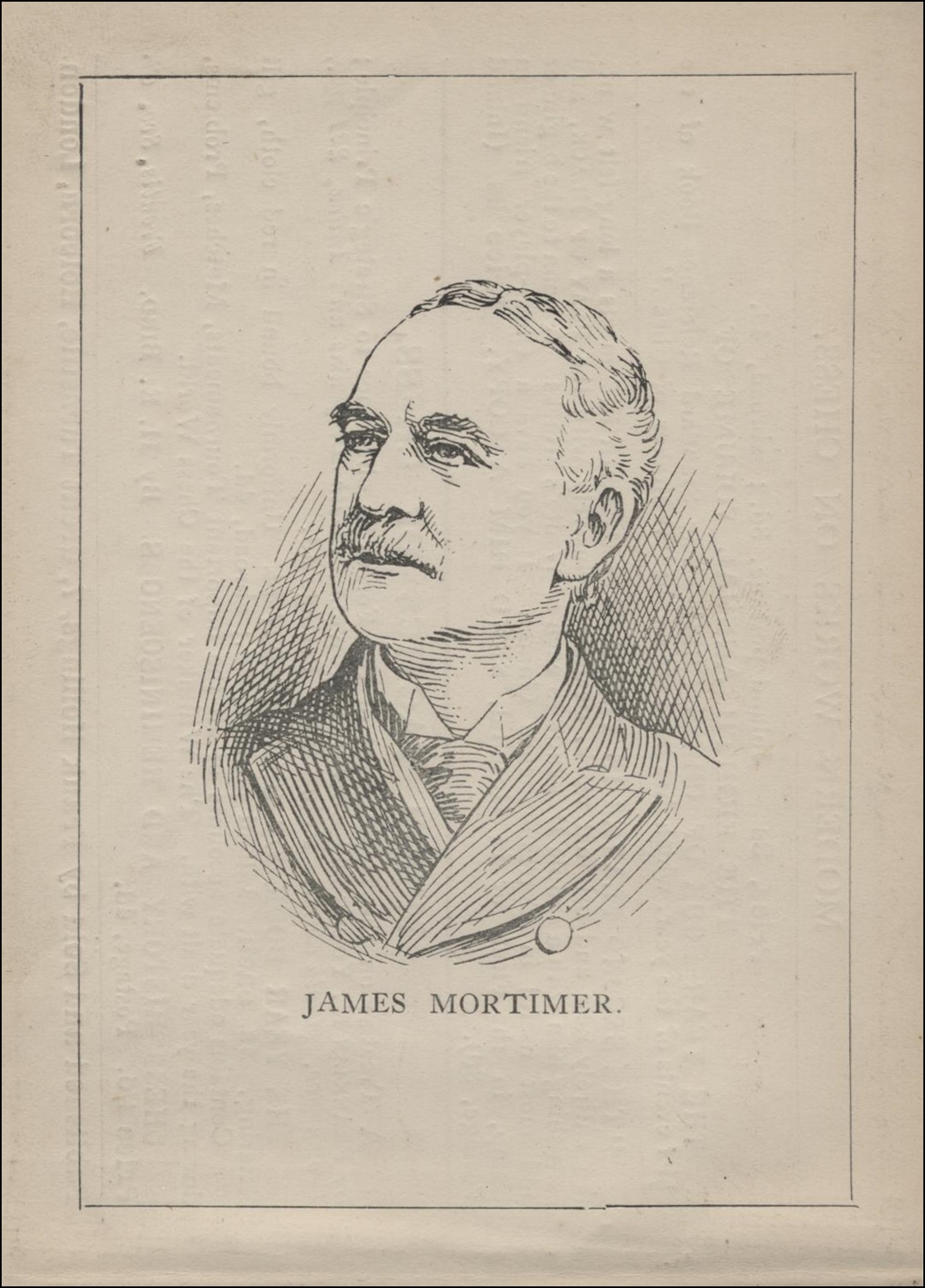
Mortimer and Morphy

The Chess Player's Handbook and Manual of the Openings, edited by James Mortimer, London 1917.


This sixteenth edition, and twenty-seventh thousand, is an enlarged version of The Chess Player's Pocket-Book and Manual of the Openings first published in 1888. The fifteenth edition had been published in 1906 and this latest edition was published posthumously, six years after Mortimer's death in 1911.


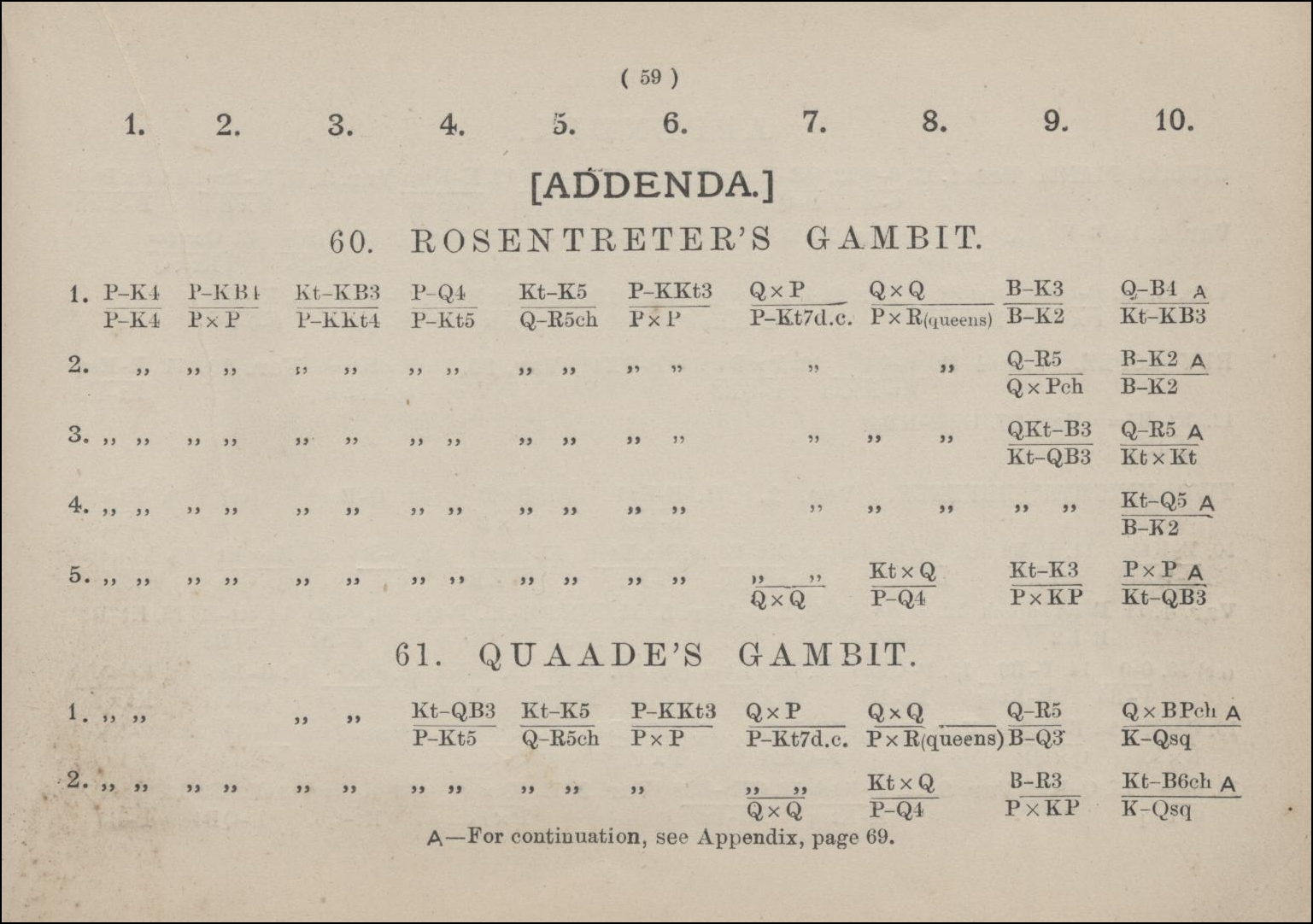
This little book contains a tabulated analysis of the openings with each line taken to 10 moves and further continuations to some lines in the Appendix.


However, the main interest lies in the Memorial Introduction giving details of Mortimer's fascinating life, an outline of which follows:

Born in Richmond, Virginia in 1833.
Resided in Paris from 1855 to 1870 as attaché to the United States Legation.
An intimate friend of Paul Morphy with whom he played many games. (Although none are recorded in the many Morphy games collections that I have checked)
Emperor Napoleon III (nephew of Napoleon Bonaparte) was another personal friend.
Moved to London in 1870 and founded the London Figaro which provided a chess column by Löwenthal and later, Steinitz.
Imprisoned following a libel case against the London Figaro.
A playwright with over 30 plays to his name, Mortimer was acquainted with many of the leading actors in England during his 40 years here.
At the age of 77 he travelled to San Sebastian for the International Tournament of 1911 as special correspondent of a leading London daily, (he was editor of the Daily Mail and Evening News). However, he was taken ill and died there on 24th February 1911.


Much more detailed information on Mortimer's life can be seen in the feature article; James Mortimer: Chessplayer and Playwright at Edward Winter's Chess Notes site.

Mortimer wrote one other chess book: The New Century Chess-Book, London 1901. A new and enlarged edition was published in 1906 with later reprints.


                ________________________________________

Morphy's Games of Chess and Frère's Problem Tournament, by Thomas Frère, New York 1859.


This is another book rushed out in the wake of Morphy's accomplishments but, as the author says in his Preface " it is simply a supply for a universal demand"
  
1859 saw the appearance of seven new works on chess in the English language, all published in America:

Science and Art of Chess, by J Monroe, New York.
The Chess Player's Instructor, by Charles Stanley, New York.
The Chess Handbook, Philadelphia. (An abridged version of Staunton's Chess Player's Handbook with new games and problems, possibly edited by Mears (Betts)).
The Book of the First American Chess Congress, by Daniel Fiske, New York.
The Exploits and Triumphs in Europe of Paul Morphy the Chess Champion, by Frederick Edge, New York. (A similar book was also published in London in the same year: Paul Morphy, the Chess Champion.)
Morphy's Games of Chess and Frère's Problem Tournament, by Thos. Frère, New York.
Morphy's Match Games, by Charles Stanley, New York.

The imprint on the reverse of the title page of Frère's book states "Entered according to Act of Congress, in the year Eighteen Hundred and Fifty-eight", but the Preface is dated January 10th 1859; this was probably the first of the books published in 1859.  


This little 144-page book has attractive blind-stamped covers and my copy has four blank leaves at each end. Frère gives a sketch of Morphy's life taken from Fiske's Chess Monthly magazines. There are 103 games with light notes but no diagrams.


The final 30 pages give 39 problems, on diagrams, from Frère's Problem Tournament followed by solutions. The problems are from a tournament conducted by Frank Leslie's Illustrated Newspaper of which Frère was chess editor. The unusual first prize, awarded to Theodore M. Brown of St. Louis, Mo.,  was "a collection of portraits of all composers who saw fit to send a single three-move problem accompanied by their likeness"


                        ________________________________________


                                             © Michael Clapham 2020