Tuesday, 17 December 2019

Russian Chess Literature; Part 3 - Early Periodicals - continued

Meanwhile back in Moscow...


7. Shashechnitsa: Ezhemesyachnyĭ Zhurnal, Moscow 1891. edited by D. I. Sargin and P. P. Bobrov. Sakharov (1968) 211, Di Felice 2439, LN 6314.


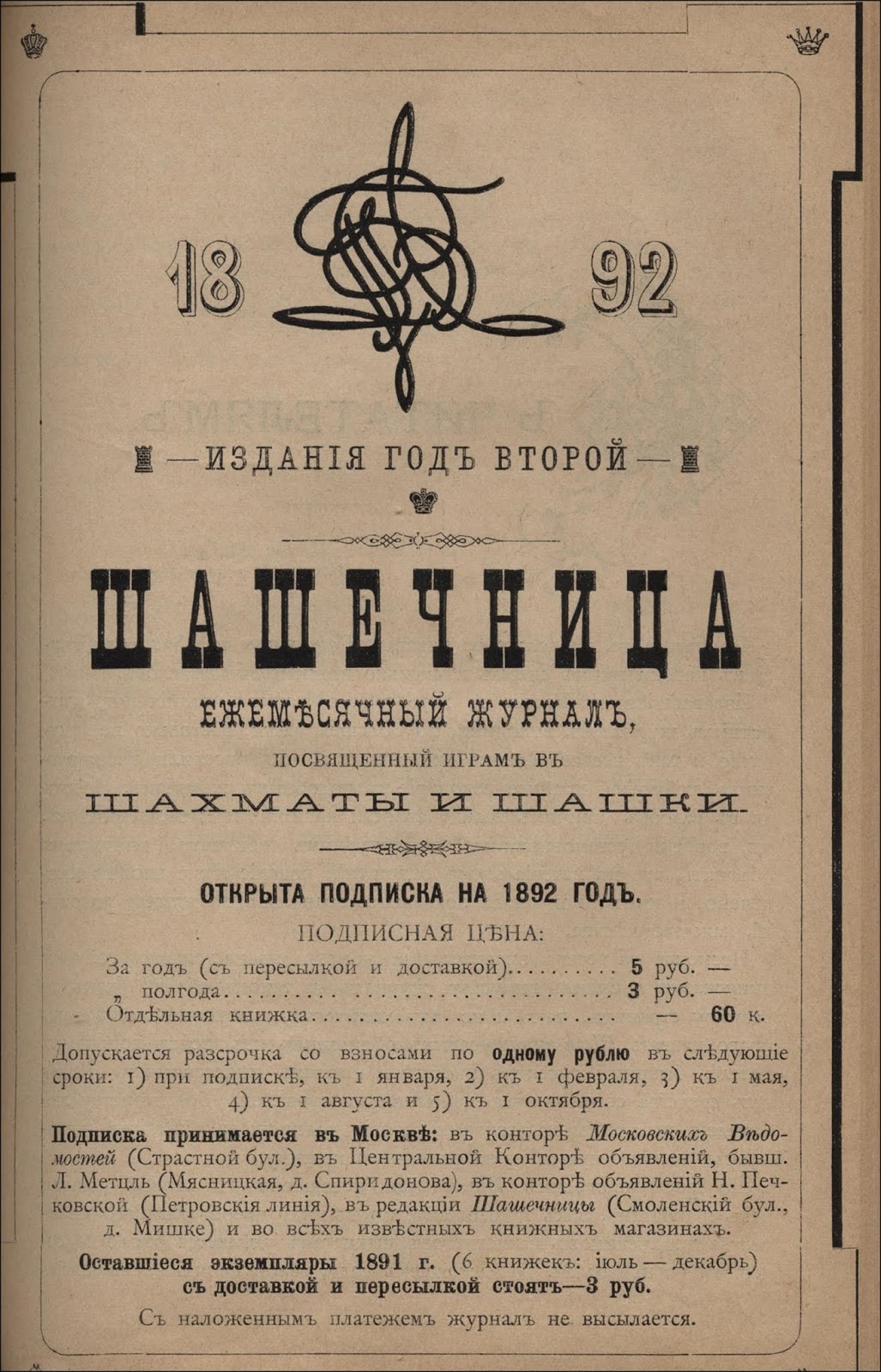
Shashechnitsa was launched in July 1891, six months after the St Petersburg magazine Shakmatnyĭ Zhurnal had commenced, and for the first time, Russia had two contemporary chess journals. Although titled Shashechnitsa (Draughtsplayer), the magazine was conceived as a publication equally devoted to chess and draughts. However, chess predominated from the outset; the first issue included 38 pages of chess and 10 pages of draughts.


Shashechnitsa, September 1891, pages 90-91


Shashechnitsa, advert for proposed volume 2
The magazine's title proved misleading to the public and after six months the journal was renamed Shakhmatnoe Obozrenie (Chess Review) and continued with the same numbering - see next item.


___________________________________

8. Shakhmatnoe Obozrenie: Ezhemesyachnyĭ Zhurnal, Posvyashchennyĭ Igram v Shakhmaty i Shashki, Moscow 1892 to 1910 intermittently. Editors: initially D. I. Sargin and P. P. Bobrov, then Sargin in 1892-93 and Bobrov from 1901 to 1910. 
Sakharov (1968) 211, Di Felice 2401, LN 6315.


As the full title indicates, this continued to be dedicated to both chess and draughts, with articles, games, problems, obituaries, news and reviews on both games included.  The magazine contained contributions from many prominent chess writers from home and abroad. There were theoretical articles by S. Alapin, A. Goncharov, I. Savenkov, A. Hardin, M. Shabelsky, etc., and M. Gonyaev wrote a number of historical essays.  The editors arranged competitions for both composing and solving chess problems.


There were long gaps in publication from 1894 to 1900, and 1905 to 1908, many issues were double, treble and even quadruple numbers, and the promised final two issues for 1904 (77 and 78) never appeared. However, during the periods 1903 to 1904 and 1909 to 1910 this was the only chess periodical in Russia. This was fortunate as the magazine was able to give wide coverage to the important 3rd All Russian Tournament held in Kiev in 1903, won by Chigorin, and the outstanding Chigorin Memorial Tournament held in St. Petersburg in 1909 - equal first Emanuel Lasker and Akiba Rubinstein.  


3rd All Russian Tournament crosstable
The editors organised a number of correspondence tournaments, and the January 1904 issue includes details of Alexander Alekhine's participation in these events as a 10 and 11-year-old.


The issue covering January, February, March and April 1909 includes two fine group photographs from the St Petersburg tournament of that year:


Several people are in both photographs.

The volume for 1909 also includes an enormous folding leaf, with seven folds, stretching to nearly a metre in length. This gives the results of the games between 34 masters up to 1909.  The overall results were as follows:


Following the death of Chigorin in 1908, Znosko-Borovsky had picked up the baton of his campaign for Russian chess unity, and published a Draft Charter of All-Russian Chess and a follow-up article: On the question of the organisation of All-Russian Chess Union, in the 1909 magazine. 

The 1909 volume included a list of subscribers with around 300 names. 


___________________________________

9. Shakhmaty: Zhurnal, Posvyashchennyĭ Shakhmatnoĭ Igrye, St. Petersburg 1894. Sakharov (1968) 212, Di Felice 2422, LN 6316.

This fortnightly magazine appeared for 12 issues between January and July 1894. Editors noted in various sources include the publisher A. S. Suvorin, M. P. Fedorov and Mikhail Chigorin. Chigorin actually contributed most of the content and M. Shabelsky also took an active part in the magazine. 

In addition to the usual material, the matches between Chigorin and Lasker in 1893, and Lasker and Steinitz in 1894 were covered.  The magazine commenced the publication of all the games between Labourdonnais and McDonnell, but only 36 of these "brilliant rejoicing inspirations of the past" had been printed before the journal closed for financial reasons. Among the books reviewed were the works of A. Binet, who explored blindfold play from a psychological viewpoint, - see LN 3406 and LN 3407. 


___________________________________

10. Tygodnik Szachowy (Chess Weekly), Warsaw 1898-1899. edited by V. Dzerzhbitsky. Sakharov (1968) 213, Di Felice 2684, LN 6280.


Published in Warsaw, Poland, which, at the time was partitioned by Russia, this was the first chess periodical in the Polish language. The magazine concentrated on chess life in Poland and included theoretical and historical articles, games, problems and also literary items including poetry. Draughts players were also catered for.

Numbers 1 to 14 in 1898, and 1 to 46 in 1899 were published, the majority of which were double numbers.  


___________________________________

11. Shakhmaty: Ezhemesyachnyĭ Zhurnal Vykhodyashchiĭ v Odesse, Odessa 1911, edited by N. E. Laurent or Loren. Sakharov (1968) 214, Di Felice 2420, LN 6319.


This, the first chess periodical published in the Motherland outside of St. Petersburg and Moscow, was launched with the aim of informing chess amateurs about the latest events in the chess world, particularly in Russia. The magazine lasted for just two issues - July and August 1911, before ceasing due to a lack of subscribers, and of suitable contributions from prominent chess players.  Capablanca was featured in the first issue.


___________________________________

12. Ershte Jiddishe Shakh-Zeitung, Lodz 1913, editors G. Salwe and M. Kryshek.

Sakharov (1968) 215, Di Felice 915, LN 6282.

As the title states, this was the first Jewish chess newspaper and just three fortnightly issues were published in partitioned Poland in October 1913. 


___________________________________

13. Shakmatnyĭ Vestnik, Moscow 1913-1916, edited by S. P. Simson.

Sakharov (1968) 216, Di Felice 2414, LN 6320.


Ostensibly a fortnightly magazine but many issues were double numbers. Alexander Alekhine's brother Alexey was the publisher and also conducted the correspondence tournaments. The editorial staff included O. S. Bernstein and D. N. Pavlov (Games), L. B. Zalkind and V. Platov (compositions), K. I. Isakov (Russian and foreign news) and A. S. Selevnev. Alexander Alekhine also contributed and features frequently in the magazine.

The International Grandmaster Tournament at St. Petersburg in 1914 naturally featured prominently, taking up most of the space in the 1st May and 15th May 1914 magazines with further games and coverage in later issues.


The magazine did much to popularise chess in Russia and took an active role in the formation of the All Russian Chess Union in 1914. The circulation reached 1,000, but high publishing costs and the onset of the First World War forced the closure in October 1916. 

This was the final chess periodical to be published in Russia before the Great October Socialist Revolution in 1917.


___________________________________

14. Izvestiya Vserossiĭskago Shakhmatnago Obshchestva, 1914 and 1916. Sakharov (1968) 217, Di Felice 1187, LN 6322.

The newly formed All Russian Chess Union issued two bulletins on its progress and activities, in 1914 and 1916, containing information on the emergence of the Union, statutes, program of activities, list of members etc. 

Issue No. 1, dated 25th June 1914 with 32 pages, was published in St. Petersburg (2,000 copies), and No. 2, although dated 15th February 1917, was included as a 12-page supplement to the September 1916 issue of the Moscow magazine Shakmatnyĭ Vestnik.


The Revolution in 1917, together with the first World War, followed by civil disturbances, brought organised chess activities in Russia almost to a standstill, and it was five years before the publication of chess periodicals recommenced in 1921. 


Bibliography - additions to previous lists:

Skinner L. & Verhoeven R, Alexander Alekhine's Chess Games, 1902-1946, Jefferson 1998. 
Feenstra Kuiper Dr. P., Hundert Jahre Schachturniere, 1851-1950, Amsterdam 1964.


                                       © Michael Clapham 2019
    

Tuesday, 10 December 2019

Russian Chess Literature; Part 2 - Early Periodicals

This second article on Russian chess literature provides information on early chess periodicals, in chronological order. Further bibliographical details can be found in Chess Literature, USSR, (1775-1966), by N. I. Sakharov, Moscow 1968, and Chess Periodicals, by Gino Di Felice, Jefferson and London 2010. The LN catalogue: Bibliotheca van der Linde-Niemeijeriana, The Hague 1955 only lists the library's holdings. 


1. Shakhmatnyĭ Listok, St Petersburg 1859 to 1863, edited by Victor Mikhailov.
Sakharov (1968) 204, Di Felice 2406, LN 6308. 

Shakhmatnyĭ Listok, 1859 title page (Moravian Chess reprint)

Shakhmatnyĭ Listok (Chess Sheet), the first Russian chess periodical, was published every month for five years from January 1859 to December 1863. The first 37 numbers were issued as a supplement to the literary and scientific journal Russkoe Slovo (Russian Word), before appearing as an independent publication from 1862 to 1863, after Russkoe Slovo had closed down.

Shakhmatnyĭ Listok, 1859, pp 8-9, courtesy of Jurgen Stigter.

The editor was the prominent chess player Victor Mikhailov (1828 - 1883) and over five years his magazine promoted chess with a wide variety of articles on contemporary events both at home and abroad, games, compositions, biographies of leading players, historical essays, etc. Petrov and Jaenisch both contributed material, and Sergey Urosov's influential Guide to the Study of Chess was serialised in the magazine from 1859 to 1861. 

Shakhmatnyĭ Listok, 1860, pp 284-285. (Moravian Chess reprint)

Shakhmatnyĭ Listok, 1861, pp 192-193. (Moravian Chess reprint)

1863 was a bumper year for the magazine with a total of 458 pages (previous years had 346, 332, 285, and 343 pages) and a full list of contents for the five volumes was included at the end of volume five. Although initially financed and published by the reputedly very wealthy G. Kushelev-Bezborodko the magazine was discontinued at the end of 1863 due to a lack of subscribers, a fate which became all too familiar for succeeding chess periodicals.  

Shakhmatnyĭ Listok, 1863, pp 450-451, Contents (Moravian Chess reprint)

_________________________


2. Shakhmatnyĭ Listok, St. Petersburg 1876 to 1881, edited by Mikhail Chigorin.
Sakharov (1968) 205, Di Felice 2408, LN 6309.


It was 13 years before the next chess periodical appeared in Russia; Adams, p46 states that from 1869 to 1876 the only chess organ in the country was Shumov's column in the weekly magazine Vsemirnaya Illustratsya, although a couple of chess columns in the German language were also published in Russian magazines during this intervening period. 

The launch of Shakhmatnyĭ Listok in 1876 was one of the initiatives by Chigorin to improve the organisation and affinity of Russian chess players. He applied to the authorities in April 1876 for permission to publish his new magazine, this was granted in June and the first issue came out in September 1876. The magazine aimed to stimulate the chess communities both in the large cities and in the provinces. The contents of the first volume for 1876 (September to December) were as follows:


Chigorin used his magazine to highlight the general disorganisation of Russian chess and suggested ways to improve this, however, it was many years before his ambition for a countrywide official chess organisation came to fruition.  
 
Chigorin published instructional articles with courses on openings and endings, games from international tournaments, beginning with Vienna 1873, annotated by himself, items on chess history, and articles on leading players including Anderssen, Morphy, and Steinitz.

The October and November 1876 issues, (pp 55-61 & 98-103) contained a bibliography of Russian chess literature compiled by M. K. Gonyaev. This listed 30 original works by Russian authors, published both at home and abroad up to 1875, translated works, and journal articles, including over 40 articles by Jaenisch published in chess periodicals around the world. The original works include a manuscript by the Russian émigré to the USA, Serge de Stchoulepnikoff; Twenty Solutions of the Problem of the Knight's Tour, Buffalo N. J. 1865; this is currently in the Cleveland Public Library.  


This first Russian chess bibliography is not recorded in Bibliotheca Van der Linde-Niemeijeriana aucta et de novo descripta, Volume I. Chess: Bibliography and History,  The Hague 1974, although other articles by Gonyaev on chess history in Shakhmatnyĭ Listok and other magazines are listed (nos. 414 to 420).


Although assisted with contributions from I. S. Shumov,  N. I. Petrovsky, E. S. Schiffers, M. K. Gonyaev and others, the bulk of the burden fell to Chigorin who produced the magazine from his own meagre resources. The monthly magazine had a stuttering existence, there was a temporary gap from July to December 1878, and many issues were double numbers covering two months. Chigorin wrote that he needed 250 subscribers for the magazine to survive, but had only 120 in 1878. This increased to 190 in 1879 but, after five years of financial struggle, he was forced to cease publication in April 1881.


Shakhmatnyĭ Listok, 1880 pp 148-149

To my eyes this was a very well produced magazine, with a varied and useful content, and at least the equal of some Western periodicals of the time. The volume for 1880 included the following four full-page portraits:

                            Paul Morphy                                           Carl Jaenisch
                          Alexander Petrov                                    Dmitry Klark


 _________________________


3. Shakhmatnyĭ Zhurnal (Chess Journal), Moscow 1882, edited by A. Hellwig.
Sakharov (1968) 206, Di Felice 2416, LN -

The first chess periodical published in Moscow, this lasted for just four issues from July to October 1882. The Introduction to the first issue stated that the magazine aimed to promote chess and draughts, giving Russian readers a complete overview of chess life in Russia and abroad, with news, games and compositions. Shakhmatnyĭ Zhurnal organised the first correspondence tournament in Russia. 

This periodical is very rare, the Cleveland Public Library only has issue no. 1 and the Royal Library at The Hague has no copies.


 _________________________


4. Shakhmatnyĭ Vestnik (Chess Herald), St. Petersburg 1885 - 1887, edited by M. I Chigorin. Sakharov (1968) 207, Di Felice 2415, LN 6310.

Shortly after the demise of Shakhmatnyĭ Listok in April 1881, Chigorin took over the chess department in Vsemirnaya Illustratsya (Universal Illustrated), following the death of the previous editor I. S. Shumov. He conducted this chess column until 1890, however, a small piece in a weekly magazine was not sufficient for Chigorin and in 1885 he launched his new chess magazine.   

This was published by the St. Petersburg Society for Chess Amateurs and commenced in July 1885. The magazine included the usual fare, but Chigorin also arranged a problem-solving competition and a correspondence tournament. A department for draughts was also included. In keeping with Chigorin's continual crusade for a unified organisation for Russian chess players, he published a Draft Charter of the Russian Chess Union in the first issue for 1886, however, it wasn't until 1914 that the All Russian Chess Union was finally established. 

The magazine closed after 18 months in January 1887 as, once again, Chigorin's energy and enthusiasm had failed to attract sufficient subscribers.   

 _________________________


5. Shakhmaty: Ezhemesyachnyi Zhurnal St. Petersburg, St. Petersburg 1890, edited by N. E. Mitropolsky. Sakharov (1968) 208, Di Felice 2419, LN 6311.

Chigorin also had a hand in this magazine although the chief editor was Mitropolsky. Articles included The Chess World 1885 - 1889, Chess departments in Russian periodicals, Russian problem composers and games from Chigorin's drawn match with Gunsberg in Havana in 1890. This magazine, which also had a small section on draughts, survived for just five issues from January to May 1890. 

 _________________________


6. Shakhmatnyĭ Zhurnal: Ezhemesyachnoe Izdanie, St. Petersburg 1891 - 1898, 1900 - 1903, editors included P. V. Otto and A. K Makarov up to 1893 and E. S. Shiffers from 1894 to 1903. Sakharov (1968) 210, Di Felice 2417, LN 6312.

This magazine was originally aimed at chess novices and players of moderate strength, i.e. the majority of Russian chess players, but otherwise included the usual mix of chess periodical matter. Although there was a break in publication from May 1898 to December 1899, it became the longest surviving Russian chess periodical to date, running to 123 issues in 13 volumes.

The latest games of Russian and foreign chess players were given along with outstanding earlier games by Morphy, Anderssen, Zuckertort, Steinitz and Chigorin etc. Problems and studies featured prominently under the sub-editorship of N. Maksimov who organised solving tourneys with competitors from Russia and abroad. Translations of Steinitz's Modern Chess Instructor were included and from 1895 a draughts department was added. 

 _________________________

To be continued.


Bibliography - additions to previous list

Adams Jimmy, Mikhail Chigorin: The Creative Chess Genius, Alkmaar 2016
Di Felice Gino, Chess Periodicals, Jefferson & London 2010 
Karpov Anatoly, Shakhmaty: Entsiklopedicheskii Slovar (Chess; Encyclopedic Dictionary), Moscow 1990
Whyld Ken, Chess Columns: A List, Olomouc 2002


   © Michael Clapham 2019

Wednesday, 6 November 2019

Russian Chess Literature: A brief history, Part one.

This is the first of a series of articles tracing the history of chess literature in Russia and the Soviet Union. The information has been compiled from many sources, mainly in the English language; these are listed in the Bibliography at the end. 

This is very much a work in progress, and further information may be added. My knowledge of the Russian language is non-existent and some of the sources give conflicting or incorrect information. Furthermore, Russian writers and historians generally praise highly their literary heritage while Western commentators are usually more measured in their views. I therefore invite comments on any errors or omissions so that a comprehensive and accurate account of Russian chess literature can eventually be completed.

Painting depicting a scene from a Russian folk epic (bylini).

The history of chess in Russia goes back over 1,000 years, but the country was a relative latecomer to the publication of books on the game. No chess manuals were printed before the 1820s and only a small number of chess books were published in Old Russia before the Great October Socialist Revolution of 1917.

Sakharov’s Chess Literature, USSR, Bibliography (1775 to 1966) lists 203 chess items plus a few periodicals up to 1917, but many of these are literary works, fiction and poems, or ephemeral items such as club reports and charters. The Catalogue of Chess Literature published in the Russian Empire, USSR and the Russian Federation, 1791 to 1992, which lists mainstream chess works,  but is incomplete, includes just 95 titles before 1917.  All chess books published before the Revolution were printed in very small numbers, generally 1,000 or less and many in editions of between 100 and 500. 


The first written mention of chess in Russia is in the Kornchaya, a 13th century document relating to ecclesiastical rules and canons. At the time the game was frowned upon by the Church and the reference in the Kornchaya is to the prohibition of chess. The Church’s hostile attitude no doubt explains why there are extremely few references to chess from the 13th to 15th centuries.  

However, as Murray notes, far from being stamped out, chess flourished more vigorously than in any part of Western Europe and there are several accounts of the popularity of chess and the proficiency of Russian players, by merchants and travellers to Russia from the 16th century onwards.   

This is commented on, for example, in Gustav Selenus’s manual Das Schach-oder Konig-Spiel published in 1616, and a particularly interesting account is given by the English historian William Coxe following a visit to Moscow in 1772 where he frequently encountered chess playing to a high standard.  (Chess by Twiss volume I, 1787 pages 26 and 27, also Murray’s A History of Chess, 1913, page 384)
 
The popularity of chess was also exhibited in the frequent references to the game in the bylini, the traditional folk epics and poems passed down by word of mouth from generation to generation. Nevertheless, there is little substance in any of these references and certainly no game scores have survived. The earliest recorded game by a Russian player in The Oxford Encyclopedia of Chess Games is dated 1838; a correspondence game between Kieseritzky and Jaenisch. It wasn’t until the late 18th century and early 19th century that Russia began publishing its own chess literature.

In 1775, A. K. Leontiev, the secretary of the Russian embassy in Peking, published a booklet in St. Petersburg; A Description of the Chinese Chess Game, which gave for the first time, the general terminology and nomenclature used in Russian chess. The Russian Academy Dictionary of 1794 also included a number of chess terms.   

The first Russian book on chess was a translation of Benjamin Franklin’s Morals of Chess, published in St Petersburg in 1791, a year after Franklin's death and five years after the first appearance of this essay in The Columbian Magazine in 1786. The Russian title actually reads Rules for Draughts, but chess in Russia was often called draughts in the late 18th century and even into the early 19th century (Linder). A copy of this very rare booklet was exhibited at the Grolier Club in 1975, the catalogue stating that only a few copies were known, other copies being in Leningrad and The Hague.

Title page of the Russian edition of Franklin's Morals of Chess
Linder, in The Art of Chess Pieces, states that this was published by Russian chess players promoting a serious attitude to the game.

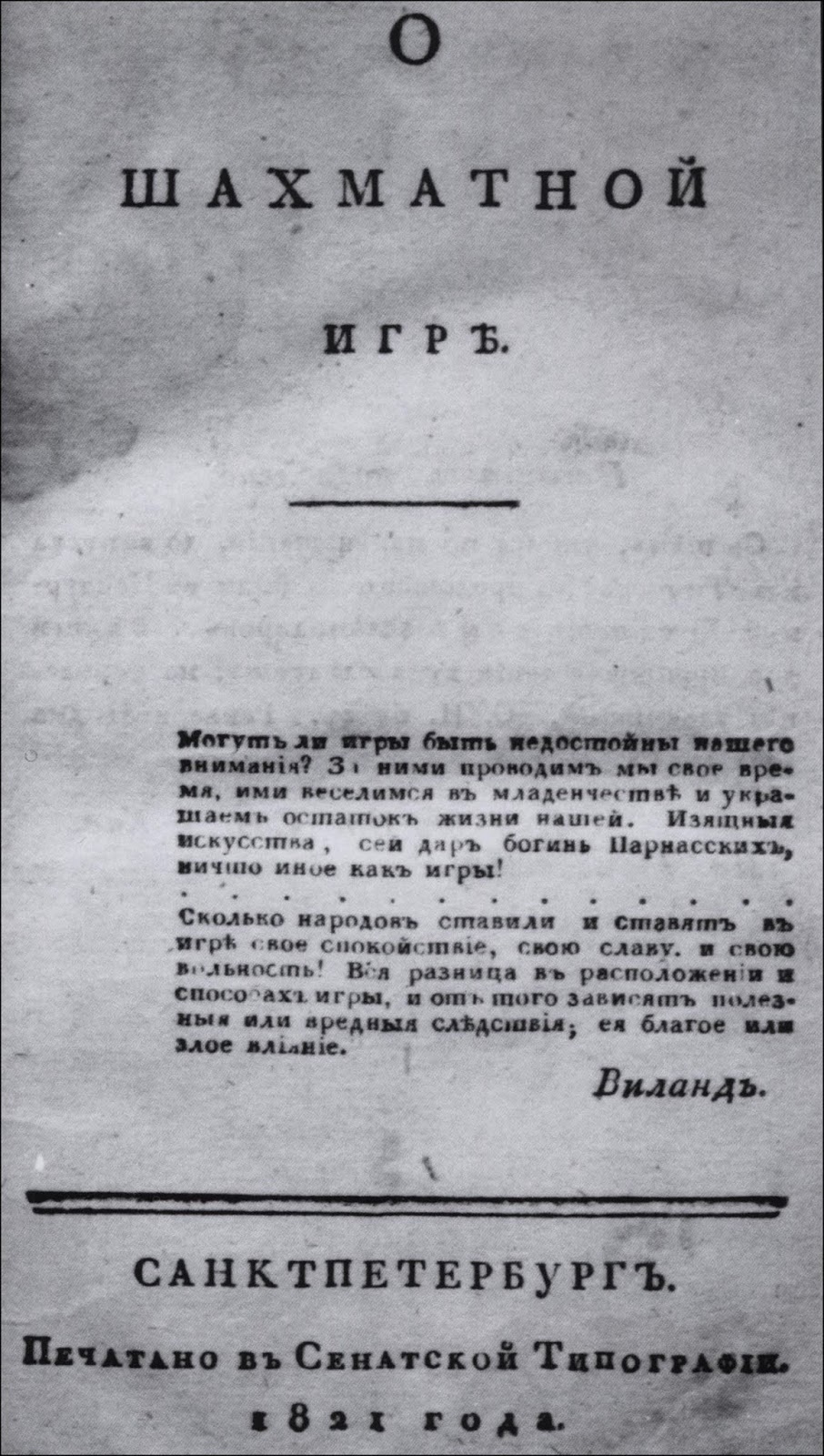
It was thirty years before the next Russian chess book appeared. This was the first instructional manual and was published in St. Petersburg in 1821 by Ivan Butrimov with the title O Shakhmatnoy Igrye (On the Game of Chess).  


Title page of Butrimov's O Shakhmatnoy Igrye, courtesy of David DeLucia.


The book was a compilation of what was known about chess theory at the time and “naturally based on Western European works” according to Murray, while Richards is more precise stating that it is largely based on the German work Codex der Schachspielkunst by J.F.W. Koch. Butrimov noted the Eastern origins of Russian chess terminology and discussed the beneficial aspects of the game, where success depends on reasoning and foresight with luck playing little part. The use of algebraic notation aided the progress of chess in Russia. 


Frontis and title of Butrimov's book


Three years later another first in Russian chess literature: Shakhmatnaya Igra (The Game of Chess), by Alexander Petrov, St. Petersburg 1824. This was a more comprehensive work than Butrimov’s book and was the first Russian manual to present a thorough and original treatment of strategy and tactics.  


Title page from Shakhmatnaya Igra by Petrov, courtesy of David DeLucia


Although dismissed by Eales as “yet another version of Philidor” it was, in fact, a book of 500 pages, written in five parts and - Linder grandly claims - “was produced after a profound study and creative reworking of all the best that was to be found in the extant chess literature.”

The third part of the book contained Philidor’s games, with extensive commentary by Petrov who was critical of some of Philidor’s views. Petrov had a deep understanding of chess and wrote intelligently on the game, emphasising the importance of study and endeavour to become proficient.  He put forward several important propositions, carried out significant analytical investigations and advanced the theory of the game.


Frontis and title of Petrov's book

R G Wade’s book Soviet Chess states that Petrov’s manual used descriptive notation but this snapshot from Linder’s Chess in Old Russia clearly shows that the notation was algebraic.  


Petrov’s book stimulated the study of opening theory and laid the foundations for the Russian school of chess. Later authors claim that the book was “rated very highly by contemporaries and it became a reference for several generations of Russian chess players” (Linder), and: “the book was extremely popular and was considered a model chess guide” (Kotov & Yudovich). However, only 300 copies were printed, (of which around 50 have survived), so its influence must have been limited.  

Alexander Petrov


Petrov, the first Russian chess master, was an associate of Butrimov and served in the chancellery of His Imperial Majesty. He wrote a number of short stories with chess as a theme including Scene from the Life of Chess Players, and also the first Russian manual on draughts.

Petrov's book was reprinted in Moscow in 1977:


_________________________________

Also published in St. Petersburg in 1824 was: Recueil de parties d’ échecs by M. Bendix. Written in French, this was a collection of games and endings. The book also included the rules of the game, adopted by the London Chess Club. (Sakharov 78)

 _________________________________

A basic primer of 39 pages was published in Moscow in 1828; The Rules of the Chess Game, (Sakharov 3). No author is named. This gave the arrangement and movement of the chess pieces, the aim of the game, notation, general notes on the conduct of the game, and a game between Philidor and Count Bruhl. 

 _________________________________

A Russian translation of Nouveau Traité du Jeu des Échecs by La Bourdonnais was published in Moscow in 1839. Petrov reviewed this book in the Russian Literary Gazette in 1840 and introduced the concept of “the art of chess” on account of its inexhaustibility and creative possibilities.  A second edition was published in Moscow in 1853.

1853 Russian edition of Nouveau Traité du Jeu des Échecs, (David DeLucia)
_________________________________

The next major contributor to Russian chess literature was the chess master and theoretician Carl (Charles?) Friedrich (Ferdinand?) von (de?) Jaenisch, referred to in some Russian sources as Karl Andreyevich Yanish. He was born in Finland, probably of German ancestry, but spent most of his life in St. Petersburg where he was employed by the Institute of Communication Engineers (Railways?).

Carl Jaenisch

Jaenisch was a frequent guest of Petrov and together they collaborated on research into the chess openings. In 1840 Jaenisch left the Institute to concentrate on his chess activities and published his major work Analyse Nouvelle des Ouvertures du Jeu des Échecs in two volumes in 1842 and 1843. The work was written in French and published in St. Petersburg, but also distributed in Paris, London and Leipzig.

Title page of Jaenisch's Analyse Nouvelle, courtesy of David DeLucia

Again, there are differing views of this work - Kotov & Yudovich describing it as the first scientific manual on openings with much original analysis, written in co-operation with Petrov, which served as the basis for many later openings manuals including Bilguer’s Handbuch des Schachspiels. However, Eales says it is “still much under the influence of Philidor”, and Murray merely states that Jaenisch and von der Lasa helped one another with their respective books; Analyse Nouvelle and the Handbuch, which both came out at a similar time.

Staunton acknowledged Jaenisch's important discoveries, in the Preface to his Chess-Player's Handbook in 1847, and English editions of Analyse Nouvelle were published in 1847, 1852 and 1855, but there was no Russian language edition.

Jaenisch wrote further chess books, which were published in French in St. Petersburg, including Decouvertes sur le Cavalier aux Échecs, 1837, a treatise on king and knight versus king and pawn endings, and Traité des applications de l’analyse mathematique au jeu des Échecs, 1862-1863, a three volume work on mathematical analysis of chess, which he was unable to complete (Kotov & Yudovich).

Jaenisch, the strong chess player, openings analyst, problem and endgame composer, chess columnist, match organiser and chess club founder was the veritable Staunton of St. Petersburg. He contributed many articles to European chess periodicals on Russian chess history, chess openings and problems; he challenged the Paris Chess Club to a correspondence game and tried to arrange a match between La Bourdonnais and Petrov, unfortunately, neither of these occurred. 

Along with Petrov and Shumov, Jaenisch was invited to the London 1851 and Paris 1867 tournaments, none was able to compete in either, but Jaenisch, arriving too late for London 1851, did stay to play a match with Staunton, losing 7 to 2 with one draw; this is the first record of a Russian playing a match abroad.

Jaenisch and G.A. Kushelev-Bezborodko, one of the richest men in Russia, established the St. Petersburg Chess Club in 1853. This attracted up to 100 members including many prominent figures in Russian culture. Jaenisch was elected secretary and drew up a set of rules and regulations, which he published, again in French, in 1854 under the title: Regles du jeu des échecs, adoptées par la sociéte des amateurs d’échecs de St. Petersburg. He published a revised charter in 1858 in both French and Russian. These were the first Russian chess codes and clarified many of the previously disputed rules.                        

________________________________
The first regular chess department in a Russian periodical was inaugurated in 1856 in Vedomosti Sankt Petersburgskiye although individual articles on chess had appeared in the periodical press as far back as 1815 in the almanack Russian Museum.


The 1850s saw much greater communication between Russian chess player's and the rest of Europe, and this stimulated an increase in the publication of chess books in the second half of the 19th century and the launch of several chess periodicals. These will be looked at in the next article. 


Bibliography and main sources of information

Bibliotheca Van der Linde – Niemeijeriana, The Hague 1955
Catalogue of Chess Literature 1791 – 1992, St. Petersburg 1993
Eales R.  Chess: The History of a Game, London 1985
Forbes D.  The History of Chess, London 1860
Gaige J.  Chess Personalia, Jefferson 1987
Kotov A. & Yudovich M.  The Soviet School of Chess, Moscow 1958
Kotov A. & Yudovich M.  The Soviet Chess School, Moscow 1983
Levy D. & O’Connell K.  Oxford Encyclopedia of Chess Games, 1981
Linde A. Van der  Geschichte und Literature des Schachspiels, Olms 1981
Linder I.M. Chess in Old Russia, Zurich 1979
Linder I.M. The Art of Chess Pieces, Moscow 1994
Murray H.J.R.  A History of Chess, Oxford 1969
Richards D.J.  Soviet Chess, Oxford 1965          
Romanovsky P.  Chess in Russia, London 1946
Sakharov N.I.  Chess Literature, USSR, (1775 – 1966), Moscow 1968
Schmid A.  Literature des Schachspiels, Wien 1847
Twiss R.      Chess, Volume I, London 1787
Wade R.G.  Soviet Chess, London 1968 


                                 © Michael Clapham 2019