Monday, 23 May 2016

Chess in Schools- Library suggestions


Chess in Schools, A Report on the Teaching of Chess, prepared by The Teaching Sub-Committee of Chess Education Society, edited by I.R. Vesselo, London, 1945, is the only book in the Chess in Education section (49) of Betts. Betts gives a date of 1943 but my copy states "first published in 1945". However, two further books relating to school chess are included in Betts section 2 on Organization. These are; Betts 2-8, Organization of the School Chess Club by the Chess Education Society, and Betts 2-10, Chess for Schools by A.F.Stammwitz, Pelham Books, London, 1966.


The Chess Education Society was formed in 1943 and a Teaching Sub-Committee was entrusted with the task of investigating the position of chess in schools and of making recommendations for its improvement. This Report includes two syllabuses and many useful suggestions for teachers.

Many well known chess personalities of the period were involved with this project including B.Goulding Brown, E.G.R.Cordingley, T.R.Dawson, R.C.Griffiths, C.S.Kipping, D.J.Morgan, H.J.R.Murray, Miss E.Saunders, P.W.Sergeant, A.R.B.Thomas, Sir G.A.Thomas and B.H.Wood, 

The book includes The Chess Library, Some Suggestions and lists 42 works in eight categories. These are mostly very common chess books but this is an excellent opportunity to present some of the popular classics from the first half of the twentieth century.


Page 1 of the Chess Library suggestions


Page 2 of the Chess Library suggestions


Note that the dust jacket of Alekhine's My Best Games of Chess 1923-1937 (reprint dated 1945) has been over-printed on previously used paper, no doubt due to paper shortages at the time. 

                                       © Michael Clapham 2016

Thursday, 19 May 2016

5,000 chess books


From The Chess Amateur, Volume XI, October 1916, page 2:

Mr. W.S. Branch notes in Cheltenham Chronicle that `he believes the number of separate chess works in all departments, and excluding magazines or pamphlets, that have been published since the invention of printing, to be now over 5,000. This does not include later editions unless much enlarged or altered. The oldest chess books, from their age and variety, are of great cash value. But this does not apply to many books, now old, but printed since the 17th century: though three or four are rare, and consequently worth a good deal more than they were published at. Captain Bertin's book of 1735 is one. Later books, but out of print long ago, generally sell at from a fourth to half what they were published at.´

Title page of The Noble Game of Chess by Capt. Joseph Bertin.

The comment by William Shelley Branch regarding `later books´ is reflected in the following advert for Frank Hollings on the back cover of The Chess Amateur for February 1907.


Incidentally, original copies of The Chess Amateur from 1916 are very scarce as all volumes from IX to XIV covering the years from 1914 to 1920 are virtually impossible to find. I do not have these myself and I have taken the above quote from the modern reprint by the Publishing House Moravian Chess, Olomouc, Czech Republic.

                                         © Michael Clapham 2016


Sunday, 15 May 2016

Here's one you haven't got !

As collectors we seek the unusual and we particularly enjoy finding items that few others, if any, have acquired.  Most of us will possess some items out of the ordinary, probably rare, and possibly unique. The item doesn't have to be very old, or even particularly valuable and, quite often, the rarest items are ephemeral, with only a few having survived.

From time to time I will put forward an item from my collection which I think falls into this category and I would be interested to hear if any other collectors have the same item.

I will first put my head above the parapet with the following brochure:


Exhibition Chess Tour featuring Lajos Portisch. This 12 page brochure was produced for participants in the tour of simultaneous displays given by Lajos Portisch at Prestige Hotels in England from 10th to 23rd February 1975, following on from his success at the 1975 Wijk aan Zee tournament. 


Portisch was the fifth highest rated player in the World at the time, behind Fischer, Karpov, Korchnoy, and Spassky but ahead of Petrosian, Tal, Larsen, Polugayevsky and Kavalek in the World's top ten.  


The brochure included a list of the tour dates and venues, the exhibition rules, a blank  score sheet,  portrait of Portisch,  brief details of his chess career and five puzzles from Portisch's games.


The eleven date tour had a maximum of 30 opponents at each display, so, with some spares, there were possibly 500 copies of this brochure printed, but how many have survived? 

                                    © Michael Clapham 2016 

Friday, 13 May 2016

The Rice Gambit


The Rice Gambit, a variation of the Kieseritsky Gambit, which is a variation of the King's Gambit, was originated by Professor Isaac Leopold Rice around 1895 and he subsequently devoted much of the next twenty years, up to his death in 1915, to researching, analysing, and testing the soundness of his gambit. 


Professor Rice sponsored many tournaments and matches in which only this opening was played and this was probably the most analysed opening variation in the early part of the 20th century. However, it has long since been abandoned in serious play and the whole episode is very curtly dismissed in The Oxford Companion.


Here I am not discussing the moves and analysis of this opening but simply outlining some of the literature on the gambit. Five editions of The Rice Gambit were published between 1898 and 1910 and, unusually, each edition had a different author/editor and a different publisher.


The first of these was The Rice Gambit by Samuel Lipshütz, published by G.P. Putnam's Sons, New York, 1898. This is a pamphlet of 23 pages with a Prefatory Note by Isaac L. Rice and analysis, by Lipshütz and Rice, of nine variations of the gambit accepted and two variations of the gambit declined.


Fifteen pages of analysis of the gambit were included in  The New Century Chess Book by James Mortimer, published by Sampson Low, Marston & Co., London, 1901, and this came to be regarded as the second edition of The Rice Gambit.


An advert for Chess Literature in American Chess Bulletin, volume IV, October 1907 page 209, included 1st, 2nd and 3rd editions of The Rice Gambit for sale, perhaps indicating that the second edition was also published separately. However I have been unable to trace any copies in major collections or libraries and perhaps it was Mortimer's book offered for sale.

Hermann Helms and Cassel Hartwig were the authors of the 3rd edition of The Rice  Gambit which was published by Treadwell, New York, 1903 or 1904. The date of publication is not given in the book and there are discrepancies in the description of this work in various sources. 

Betts 15-8 indicates a date of 1904 and 31 pages, even mentioning pages 27 and 29-31. However, Cleveland Public Library states 1903 and 26 +1 pages. The David DeLucia Chess Library catalogue, published in 2009 states 1903 and 26 pages.

The 4th edition of The Rice Gambit edited by Hermann Keidanz was published as a Souvenir Supplement of the American Chess Bulletin in New York, 1905. This was a substantial work of 111 pages and contained 108 variations of the gambit as well as a record of the tournaments devoted to testing it. Further supplements to the 4th edition, also by Keidanz, were published by American Chess Bulletin in 1909 and 1910, these contained 17 pages and 16 pages respectively. 


The fifth edition of The Rice Gambit was edited by Dr. Emanuel Lasker who also published the book, of 43 pages, in New York, 1910. Lasker gives only a luke warm endorsement to the gambit in his introduction stating that `the gambit will not yield to the first player as high a percentage of wins as the Ruy Lopez or the queen's pawn´ but acknowledges the `beauty hidden in the gambit´ and concludes that `the Rice Gambit will ever be a valuable asset for the analyst, the player, and the student´.

Lasker was secretary of the Rice Gambit Association formed in October 1904 with Professor Rice as president.

A Supplement to the fifth edition by Oldrich Duras was published by American Chess  Bulletin, New York, 1914. 

The only book published in English on a Rice Gambit tournament is Rice Gambit Consultation Tournament by Gustav H. Koehler, New York, 1910. This includes an analytical survey of the gambit, nine games from the tournament with annotations, and portraits of the players.  

 Twenty Years of the Rice Gambit page 372


A year after Professor Rice's death, Twenty Years of the Rice Gambit was published by American Chess  Bulletin, New York, 1916. Edited by Hermann Keidanz, this lavish work is the final monument to Professor Rice's gambit.


The book has 399 pages including over 250 pages of analysis and variations followed by an Appendix of over 100 pages containing biographical articles on Professor Rice, obituaries, resolutions by numerous Clubs and Institutions following Rice's death and results of various Rice Gambit tournaments and matches.

 
Folded leaf from Twenty Years of the Rice Gambit
                                 
                                         © Michael Clapham

Wednesday, 4 May 2016

Howard Staunton on previous chess writers

Following on from the article on 3rd May:

Although Staunton had not discussed in detail previous chess writers and players until he wrote his final work Chess: Laws and Practice, London, 1876, he had an extensive knowledge of all of the main authors that preceded him and he made numerous references to these in his first book The Chess-Player's Handbook, London, 1847.


In the Preface to The Chess-Player's Handbook Staunton states;   `Adopting the common basis founded by the earlier writers, Lopez, Salvio, Greco, Cozio, Lolli etc., and super-adding the important discoveries brought to light in the works of Bilguer and Jaenisch, I have aimed only at producing an instructive compendium available by the large majority of English players to whom those works are inaccessible.´

Staunton lists the leading works to be consulted for each opening and includes works by Damiano, Lopez, Selenus, Greco, Cozio, Lolli, Ponziani (a particular favourite), Stamma, del Rio, Bertin, Salvio, Gianutio, Carrera, Philidor, and all of the authors from the early years of the 19th century including Sarratt, Silberschmidt, Horny, Mouret, Lewis, Bilguer and der Lasa, de la Bourdonnais, Ghulam Kassim, Jaenisch, Walker and Bledow.  

There are far fewer references to other chess works and writers in Staunton's next two major treatises, The Chess-Player's Companion, London, 1849 and Chess Praxis, London, 1860.


The Chess Player's Companion, (which has a particularly attractive title page and frontis in the first edition) mentions, in the section On Odds at pages 380 et seq., Damiano, Lopez, Carrera (by Lewis), Salvio, Cozio, Traité des Amateurs, Trevangadacharya Shastree and Alexandre, while various previous writers are referred to in the discussion on the laws of chess in Chess Praxis at pages vii to xii. 


It is clear that Staunton had access to a substantial library of chess books although some of the information from earlier works could have been gleaned from later writers.

                                           © Michael Clapham

Tuesday, 3 May 2016

The Laws and Practice of Chess


Howard Staunton's final chess book was published in 1876 two years after his death, having been prepared for publication by Robert Bownas Wormald from Staunton's manuscript. The first edition is titled Chess: Theory and Practice, but the second edition, also published in 1876, and all later editions, have the title The Laws and Practice of Chess. (Wormald died in 1876)


    Howard Staunton                                         Robert Bownas Wormald

 
The book is inscribed to J. Rimington Wilson the famous 19th century chess book collector. 


In his brief Preface Wormald declares `It has been my main object to make neither alterations nor additions, except when absolutely necessary, but to give the book to the reader, as nearly as possible, as it left the late Mr. Staunton's hands.´


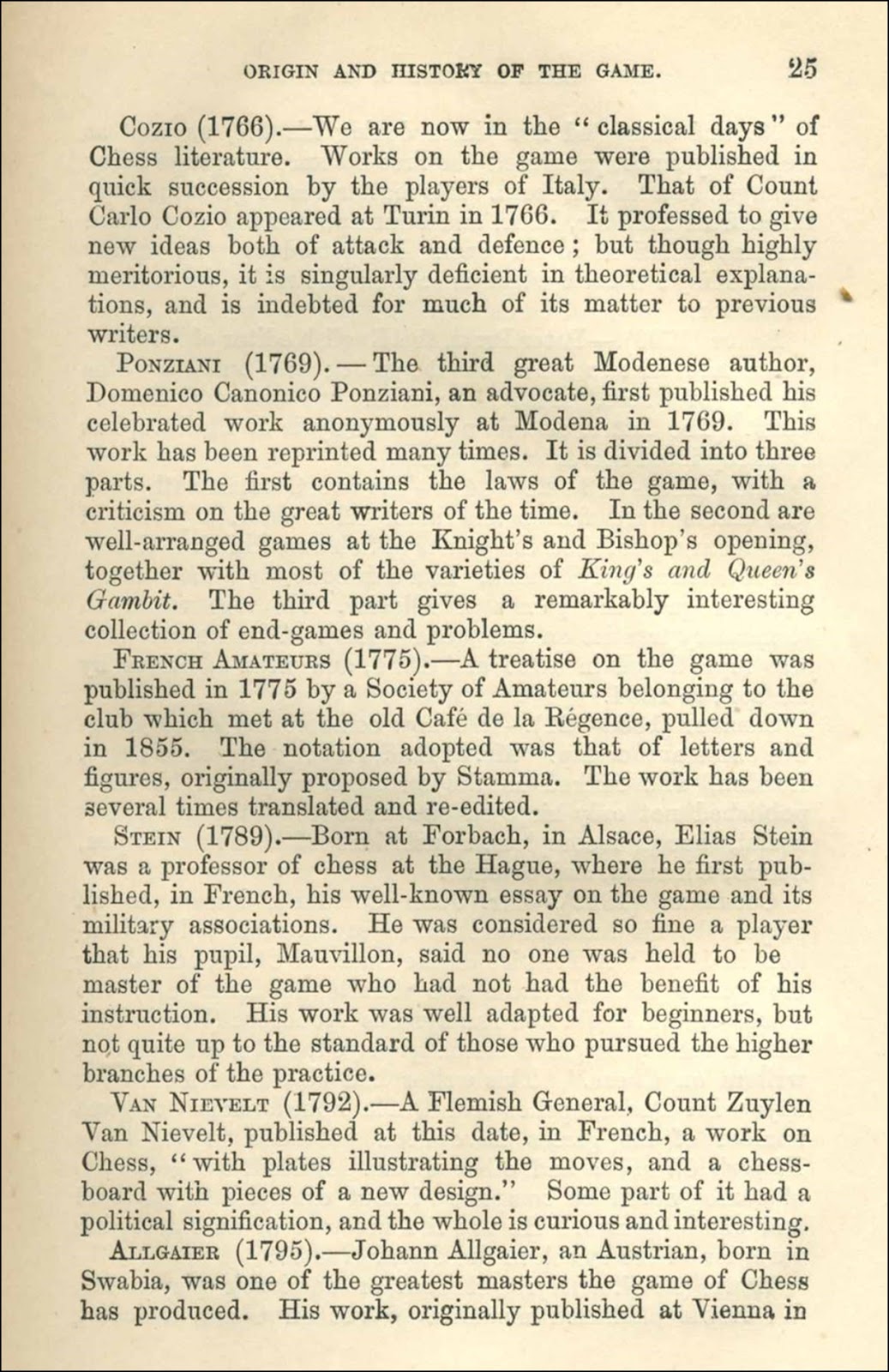
Of particular interest to chess bibliophiles is that, for the first time in his chess books, Staunton includes much interesting information on previous players and writers on the game. This is included in a chapter on the Origin and History of the Game of Chess.

He gives details of most of the major chess works from Cessolis, Vicente and Lucena in the 15th century down to Sarratt, Cochrane, Lewis and Alexandre in the 19th century. 


Having `exhausted the historic period´ Staunton then lists the names of the major contemporary players and writers from France, Germany, England, USA, Russia and Italy, and concludes with the following:


It is perhaps surprising that, while Staunton was one of the most influential chess writers of the nineteenth century, and was also widely regarded for a number of years as the World's leading chess player, there is not a word about his own achievements either as writer or player. 

  
                                     © Michael Clapham 2016